
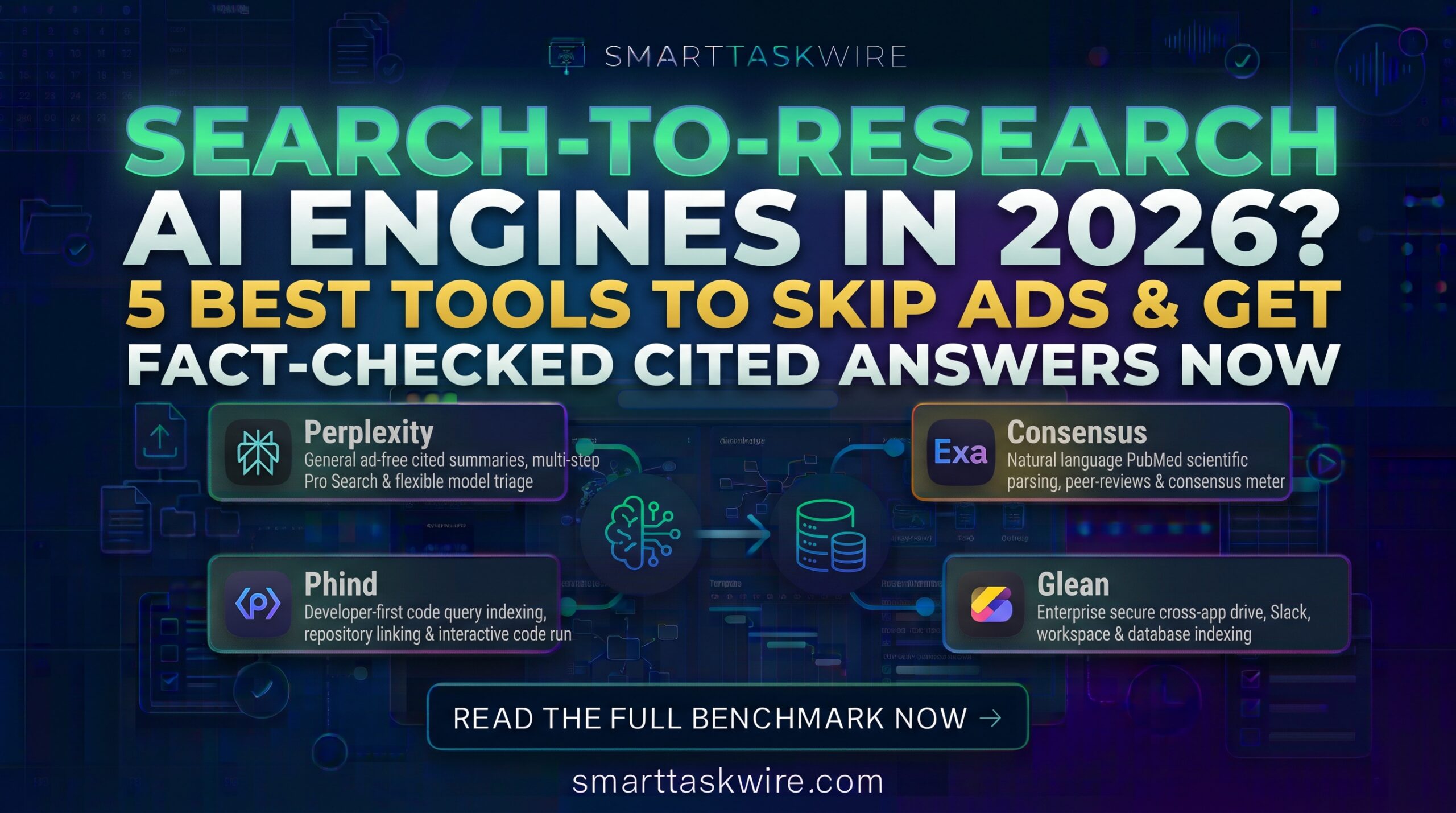
5 Best Search-to-Research AI Engines 2026 (For Fast, Ad-Free Answers)
Table of Contents
Finding high-quality, trustworthy information on the traditional web has become an uphill battle. Search engine results are cluttered with sponsored ads, AI-generated search engine optimization (SEO) clickbait, and endless cookie consent banners. Gathering facts, cross-referencing sources, and compiling research can require browsing dozens of separate, ad-heavy tabs.
By late 2026, a new category has emerged to solve this fatigue: search-to-research AI engines 2026. Rather than simply returning a list of links, these advanced generative platforms scan the live web, synthesize complex answers, and provide direct, inline citations for every fact they state. They effectively behave as automated research assistants, allowing users to skip SEO spam entirely and access the primary sources directly.
Whether you are a developer debugging code, a student compiling academic papers, or an entrepreneur researching market trends, choosing the right companion is critical. Here is our benchmark of the five best search-to-research AI engines in 2026.
Comparison of Top Search-to-Research AI Engines in 2026
| Platform | Best For | Focus Area | High-Impact Feature | Access Model |
| Perplexity | General web search & research | All-purpose synthesis | “Pro Search” multi-step interactive questioning | Free tier / Pro starts at $20/mo |
| Phind | Developers & technical troubleshooting | Code generation & debugging | Real-time codebase referencing and runtime emulation | Free tier available / Pro from $20/mo |
| Consensus | Academic, medical & scientific research | Scientific paper analysis | Synthesis of peer-reviewed data with consensus meters | Free basic / Premium from $8.99/mo |
| Exa (formerly Metaphor) | Neural & custom database discovery | Large-scale scraping | High-fidelity natural language web query parsing | Free credits / Paid API plans |
| Glean | Internal enterprise knowledge | Corporate intranets | Real-time indexing across Slack, Drive, and internal databases | Enterprise subscription |
1. Perplexity: The All-Purpose Information Engine
Best for: General search, everyday research, and multi-step investigation.
Perplexity is the gold standard of search-to-research AI engines 2026. It replaced traditional keyword search for millions by providing conversational, cited summaries of any topic on the live web.
- Interactive Pro Search: For complex queries, Perplexity doesn’t just return one answer. It asks clarifying questions, executes multiple search passes, and synthesizes its findings into deep, multi-page research documents.
- Inline Citation Mapping: Clickable numeric citations appear next to almost every claim, letting users instantly inspect source material and bypass search spam.
- Flexible Model Selection: Subscribers can toggle between top-tier reasoning models like OpenAI’s o1, Anthropic’s Claude, and specialized open-source engines depending on the research type.
- Limitations: Multi-step Pro Search passes can occasionally feel slower than instant, basic queries.
Perplexity remains the market leader in the search-to-research AI engines 2026 category for anyone wanting cited, synthesized facts on any subject.
2. Phind: The Developer’s Answer Engine
Best for: Software engineers, data scientists, and technicians looking to bypass outdated code forums.
While search engines often prioritize outdated blog posts or sponsored coding courses, Phind was engineered specifically for technical research. It indexes the live developer web—documentation, repositories, and forums—to provide functional code and troubleshooting answers.
- Codebase Awareness: Connect Phind directly to your local codebase or Git repositories to find bugs and check implementations across files.
- Real-time Web Searching: Looks up official API documentation and framework updates to ensure recommended code is secure and current.
- Interactive Code Runner: Test the suggested visual scripts and terminal operations inside a built-in interactive sandbox before deploying.
- Limitations: Specialized for technical subjects and less effective for general non-technical queries.
For developers and technical teams, Phind is the standout low-friction research platform in search-to-research AI engines 2026.
3. Consensus: The Scientific and Academic Authority
Best for: Students, clinicians, and researchers seeking evidence-based scientific facts.
When researching health, science, or public policy, search engines frequently surface unverified opinions or sponsored health blogs. Consensus provides a trustworthy alternative by searching only peer-reviewed academic databases.
- Natural Language Queries: Ask everyday questions like “Does caffeine impact sleep quality?” and let the system search millions of scientific papers.
- Consensus Meter: Evaluates the collective weight of scientific literature, illustrating the percentage of studies that agree, disagree, or are neutral.
- Automated Scientific Citation: Provides direct citations from PubMed, ArXiv, and other verified academic indexes with zero SEO influence.
- Limitations: Limited to peer-reviewed academic literature, meaning it cannot research pop culture or real-time breaking news.
Consensus is the most reliable academic companion in the search-to-research AI engines 2026 landscape.
4. Exa: The Neural Search Engine for Web Scraping
Best for: Power users, researchers, and developers who need raw, high-quality links based on natural context.
Most search engines rely on keyword matching, which can make it difficult to locate highly specific documents or datasets. Exa uses a neural approach to find links based on the underlying meaning of your request.
- “Search like you think” Queries: Instead of typing search terms, use conversational prompts like “Here is a list of the top hardware startups that raised Seed rounds in Boston.” Exa interprets the target format and gathers the exact links.
- Deep Content Scraping: Fetch clean, Markdown-formatted text directly from target pages via the API, perfect for importing into other tools.
- Targeted Result Filtering: Isolate searches by date, domain, or specific file type (e.g., PDF) to bypass spam.
- Limitations: Designed to return high-quality links and raw text rather than synthesizing narrative summaries.
Exa is a powerful neural scraping tool for advanced web research in search-to-research AI engines 2026.
5. Glean: The Enterprise Internal Research Engine
Best for: Companies and organizations needing to find internal documents, messages, and files instantly.
While other tools scan the public web, large teams often struggle to find files lost within their own company drives, chats, and databases. Glean solves this enterprise knowledge gap.
- Cross-App Search indexing: Connects to Slack, Google Drive, Microsoft 365, Salesforce, and internal wikis to make all corporate information searchable from a single dashboard.
- Enterprise Security & Privacy: Respects all existing file permissions, ensuring employees only see the documents they have access to.
- Contextual Corporate Q&A: Synthesizes internal search answers to explain company policies or project updates with inline source citations.
- Limitations: Built for enterprise teams with private servers, meaning it does not have a free public tier.
Glean provides critical productivity for teams seeking to unify scattered company information in search-to-research AI engines 2026.
How to Scale Your Research Workflow
To make the most of search-to-research AI engines 2026, connect your synthesized facts with standard business automations:
- Map Project Workloads: Move newly discovered research straight into team task boards using our benchmark of the Best AI Project Management Tools.
- Draft Client Briefs: Convert cited research summaries into engaging copy using our favorite Best AI Copywriting Tools.
- Automate Document Delivery: Send search outputs directly to your databases using our curated Best Low-Code AI Workflow Automation Tools in 2026.
Embracing search-to-research AI engines 2026 helps you skip search engine bloat, get fast answers, and keep your focus on getting things done.
5 Best Low-Code AI Workflow Automation Tools 2026 (That You Can Actually Self-Host)