5 Best Open Source AI Agent Frameworks 2026 (Self-Hosted & Private)
Table of Contents
Relying on closed, hosted chatbot APIs leaves businesses vulnerable to sudden pricing spikes, opaque data-retention policies, and strict context-window quotas. In late 2026, tech-forward builders are shifting toward open source AI agent frameworks 2026 to build, inspect, and host their own autonomous multi-agent systems.
Unlike simple single-turn text completions, modern autonomous agents break complex assignments down into iterative sub-tasks, execute terminal and browser tools, query internal vector databases, and collaborate with specialized teammate agents. Running these engines on your own virtual private server or local workstation gives you total data sovereignty, zero platform markups, and unfiltered access to open-weight models.
Whether you need to build self-directed research squads, automate repetitive software maintenance, or manage complex enterprise data pipelines, choosing the right architecture matters. Here is an in-depth benchmark of the five best open source AI agent frameworks in 2026.
Comparison of Top Open Source AI Agent Frameworks in 2026
| Platform | Best For | Primary Language / Stack | Architecture Style | Licensing & Hosting |
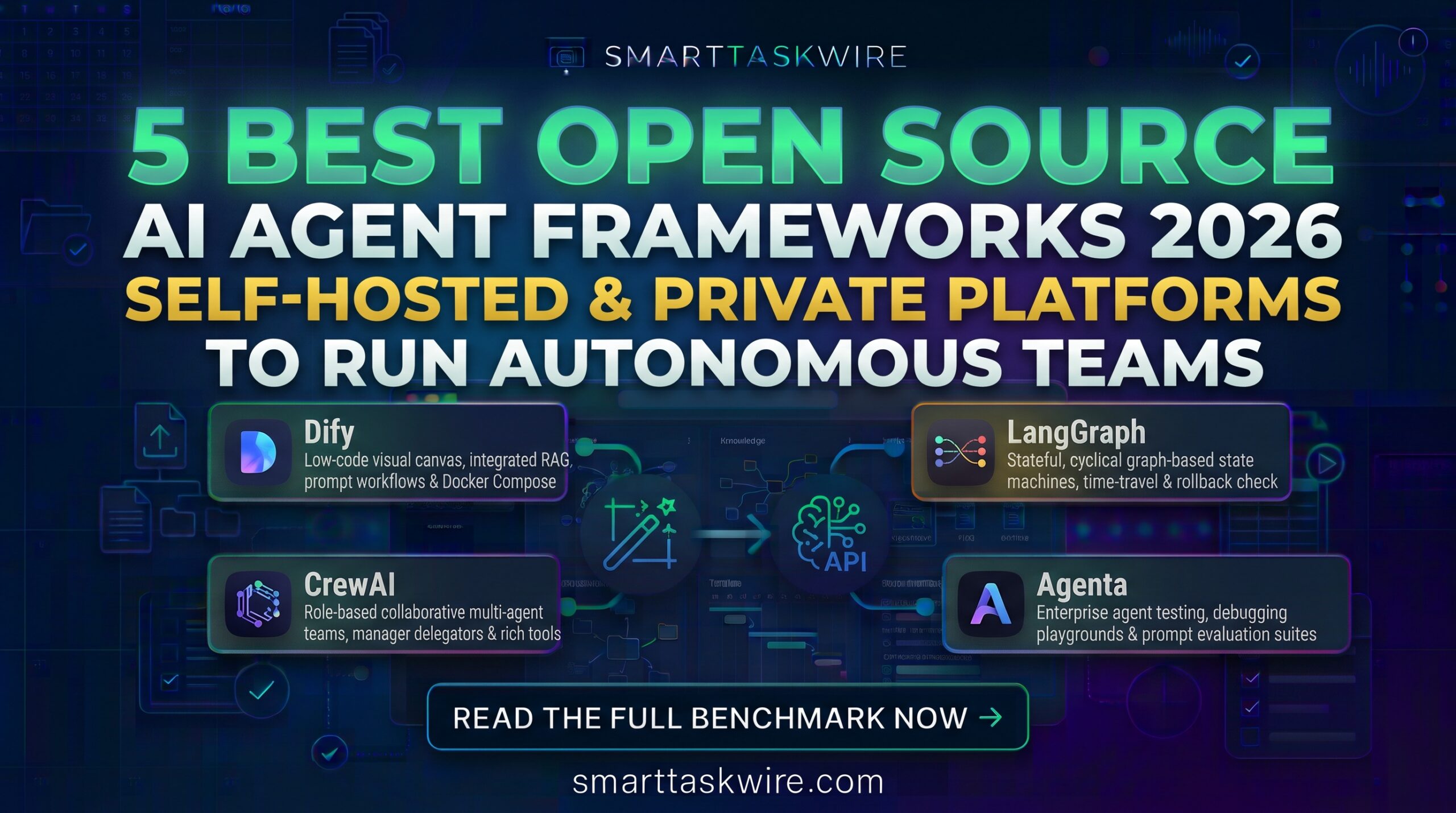
| Dify | Low-code teams & visual app orchestration | Python / Next.js UI | Visual canvas, integrated RAG, and prompt workflows | Open Source (Self-host via Docker) |
| CrewAI | Role-based autonomous multi-agent teams | Python | Collaborative agents with defined roles, goals, and backstories | MIT Open Source (Cloud option available) |
| LangGraph | Complex, cyclical, and stateful workflows | Python & JavaScript | Graph-based state machine with branching and human-in-the-loop | MIT Open Source (Self-hosted or LangSmith) |
| Mastra | Full-stack TypeScript web applications | TypeScript / Node.js | Type-safe orchestration, evals, and direct tool calling | Apache 2.0 (Self-host anywhere) |
| Agenta | Enterprise agent testing, evals & prompt ops | Python / TypeScript | Collaborative playground, observability, and local deployment | Open Source (Docker self-hosted) |
1. Dify: The Visual Standard for Self-Hosted Agent Workflows
Best for: Cross-functional teams that need an intuitive visual builder without sacrificing self-hosting flexibility.
For organizations that want the developer power of an agentic framework combined with an accessible drag-and-drop user interface, Dify stands out among open source AI agent frameworks 2026. Dify allows operators to design complex multi-step agents, visual prompt chains, and Retrieval-Augmented Generation (RAG) pipelines without writing endless glue code.
- Visual Agent Designer: Drag and drop LLM blocks, tool-calling nodes, and external API connectors on an interactive graph canvas.
- Integrated Knowledge Hub: Upload PDFs, markdown files, and Notion exports directly into an integrated vector database engine.
- One-Click Local Deployment: Spin up the entire multi-container stack—including Postgres, Redis, and vector stores—using a simple Docker Compose file.
- Drawback: Fine-grained custom code execution inside intermediate nodes can feel restrictive compared to raw Python environments.
Dify leads the open source AI agent frameworks 2026 landscape for teams that want rapid visual assembly alongside full local hosting.
2. CrewAI: The Leader in Role-Playing Multi-Agent Collaboration
Best for: Developers looking to assemble specialized teams of agents that collaborate like human departments.
Rather than building a single monolithic agent that attempts to handle every task, CrewAI structures intelligence through specialization. It secures an essential place within open source AI agent frameworks 2026 by making team orchestration straightforward.
- Persona-Driven Logic: Define agents with discrete job titles, operational goals, and detailed backstories to ground their decision-making.
- Hierarchical Task Delegation: Set up manager agents that dynamically review work, request revisions, and delegate sub-tasks to specialist agents.
- Rich Tool Ecosystem: Connect agents to search engines, scrapers, GitHub repositories, and local Python execution sandboxes out of the box.
- Drawback: Highly conversational agent crews can consume substantial input tokens if interaction loops are not strictly bounded.
For creative agencies, research collectives, and content operations, CrewAI provides one of the most intuitive multi-agent architectures available.
3. LangGraph: The Gold Standard for Mission-Critical Stateful Pipelines
Best for: Software engineers building resilient, production-ready AI systems with branching logic and rollback capabilities.
While simple agent loops can derail into infinite hallucination spirals, LangGraph treats agentic execution as a cyclical state graph. This makes it the engineering benchmark in open source AI agent frameworks 2026 for projects where reliability and state persistence are non-negotiable.
- Graph-Based Orchestration: Model agents as nodes and edges, allowing precise control over conditional loops, branches, and termination conditions.
- Built-In Time Travel & Checkpointing: Save the state after every tool execution, enabling human operators to pause, rewind, or edit memory mid-flight.
- Human-in-the-Loop Support: Pause automated tasks at critical decision points to request manual human approval before taking irreversible actions.
- Drawback: The learning curve is steep; mastering state schemas and graph transitions requires solid software architecture skills.
When software failure is not an option, LangGraph is the most robust open-source choice for running production-grade AI agents.
4. Mastra: The Full-Stack TypeScript Specialist
Best for: JavaScript and TypeScript developers building native web applications with embedded agent capabilities.
Most agent frameworks were developed primarily for Python environments, leaving front-end and full-stack web developers forced to maintain separate microservices. Mastra solves this within open source AI agent frameworks 2026 by delivering an enterprise-ready framework engineered specifically for TypeScript and Node.js.
- End-to-End Type Safety: Build agents, tool parameters, and response schemas with full TypeScript validation across your stack.
- Lightweight Footprint: Exceptionally low execution latency and minimal token overhead compared to heavy Python runtimes.
- Built-in Observability & Evals: Inspect agent decisions, track token costs, and evaluate output quality natively from your terminal.
- Drawback: A younger ecosystem than LangChain, meaning fewer legacy community plugins.
Mastra is the premier framework in open source AI agent frameworks 2026 for modern web development teams shipping TypeScript products.
5. Agenta: Enterprise Evaluation, Observability, and Prompt Ops
Best for: Development teams needing collaborative testing and strict observability before deploying agents.
Deploying autonomous agents into production without testing frameworks often leads to breaking bugs and unintended tool calls. Agenta rounds out the top tier of open source AI agent frameworks 2026 by focusing directly on agent evaluation and debugging.
- Visual Prompt Playground: Compare different model outputs, test system prompts side-by-side, and iterate on edge cases without redeploying code.
- Deterministic Evaluation Suites: Run automated test cases against agent outputs to catch hallucinations and prompt injection vulnerabilities.
- Privacy-First Self-Hosting: Run the entire Agenta observability stack on your own bare-metal or cloud instances to safeguard internal data.
- Drawback: Designed as an evaluation and operations workbench rather than a direct runtime agent framework itself.
Agenta delivers essential infrastructure for engineering teams committed to deploying secure, trustworthy autonomous systems.
How to Build a Private, High-Velocity AI Tech Stack
To scale your deployment of open source AI agent frameworks 2026, integrate your agentic workflows into a comprehensive operational architecture:
- Wire Visual Automations: Connect your self-hosted agent nodes with third-party webhooks using our benchmark of the Best Low-Code AI Workflow Automation Tools in 2026.
- Speed Up Code Refactoring: Use cutting-edge coding assistants to modify agent tool libraries from our guide to Vibe Coding Tools 2026.
- Organize System Documentation: Maintain agent system prompts, architecture diagrams, and testing logs with our vetted list of the Best AI Knowledge Management Tools.
Adopting open source AI agent frameworks 2026 ensures your technical systems remain completely within your control, private, and resilient against cloud vendor changes.
5 Best Low-Code AI Workflow Automation Tools 2026 (That You Can Actually Self-Host)