
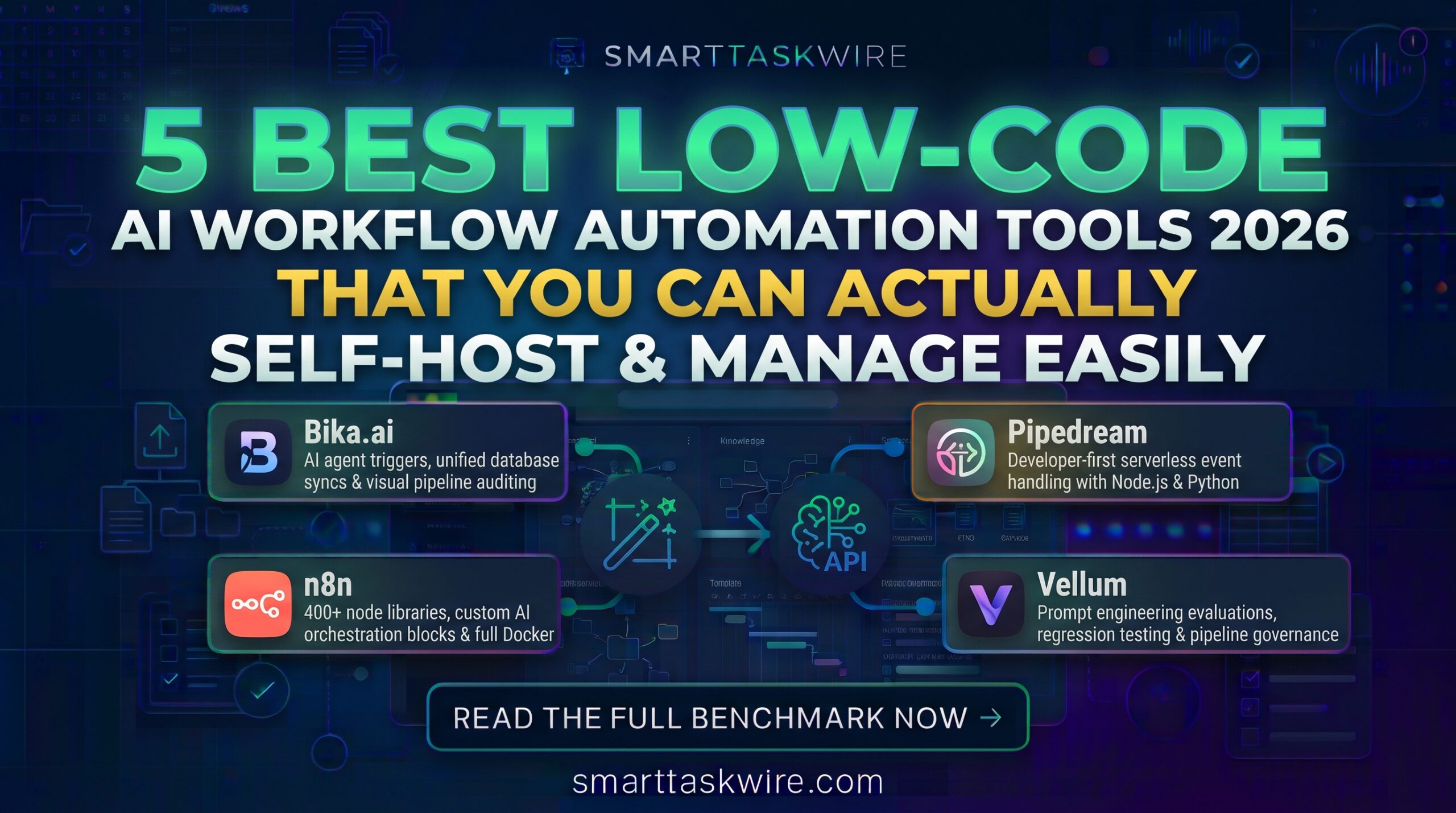
5 Best Low-Code AI Workflow Automation Tools 2026 (That You Can Actually Self-Host)
Table of Contents
Building a modern business requires managing dozens of disconnected software services. You need a way to qualify inbound leads, parse multi-format customer data, trigger API notifications, and keep your workspace databases synced. Connecting these tools historically meant maintaining extensive scripts or paying massive fees to traditional cloud integration platforms.
In late 2026, the rise of low-code AI workflow automation tools 2026 has changed this completely. Today’s visual workflow orchestrators do not just execute simple “if this, then that” pipelines; they process unstructured data, use vector databases for memory, and manage autonomous agentic loops on their own.
More importantly, forward-thinking organizations are prioritizing self-hostable tools. Keeping your automation environment on your own servers protects data privacy, prevents API vendor lock-in, and eliminates the expensive run-time fees associated with cloud-only platforms.
Whether you need to build custom agentic pipelines or connect enterprise APIs visually, choosing the right platform can save you dozens of engineering hours. Here is our hands-on benchmark of the five best low-code AI workflow automation tools in 2026.
Low-Code AI Workflow Automation Tools 2026 Comparison
| Platform | Best For | Code Level | Primary Focus | Licensing / Self-Hosting |
| Bika.ai | Multi-System Orchestration | Low (JavaScript/Python) | Native AI agent triggers, database syncs, and visual pipeline auditing | Open-core (Fully self-hostable) |
| n8n | Technical Teams & Developer Workflows | Low to Medium | 400+ built-in node libraries with custom AI orchestration blocks | Open-fair-code (Fully self-hostable) |
| Gumloop | Deep Web Research & AI Agents | None to Low | Visual scrapers, data pipelines, and multi-modal parsing | Cloud-only (Enterprise on-prem option) |
| Pipedream | Developer-First Serverless Pipelines | Low to Medium | Code-centric connectors, async polling, and custom webhook triggers | Managed cloud (Docker self-hosting option) |
| Vellum | Enterprise Production Testing & Governance | Low | Prompt engineering evaluation, agent backtesting, and observability | Enterprise Cloud (Private cloud options) |
1. Bika.ai: The Ultimate AI-Driven Orchestration System
Best for: Visual team collaboration, automated data workflows, and deploying connected AI agents with zero API hurdles.
Bika.ai has rapidly become a standard for low-code AI workflow automation tools 2026. Built to operate as an visual engine, Bika.ai makes it easy to integrate intelligent processing into every step of your operation.
Key Strengths:
- Native Agent Integration: Connects AI-powered bots and research agents directly into multi-step pipelines without complex API scripting.
- Unified Workspace Databases: Bridges internal tables with external services, allowing data to be processed and enriched automatically based on specific triggers.
- Granular Visual Pipeline Auditing: Monitors loops and conditional checks visually, ensuring human operators can track, audit, and inspect AI decisions instantly.
Drawbacks:
- Building highly customized database architectures requires spending a brief period understanding Bika.ai’s relational workspaces.
For teams that want to turn multi-step tasks into self-running, smart processes without the burden of complex system coding, Bika.ai leads low-code AI workflow automation tools 2026.
2. n8n: The Professional Standard for Technical Self-Hosting
Best for: Technical teams, developers, and organizations prioritizing custom code escapes and open-source hosting.
n8n has established itself as the visual standard for technical low-code AI workflow automation tools 2026. By giving developers the freedom to choose between visual building and custom JavaScript or Python scripting, n8n fits perfectly into complex infrastructure pipelines.
Key Strengths:
- True Self-Hosting Freedom: Can be deployed anywhere via Docker, allowing teams to keep sensitive data on their own servers and avoid metered run-time costs.
- Visual AI Builder & Vector Nodes: Features dedicated nodes for vector stores, memory loops, and custom agents directly on the dashboard.
- Custom Code Flexibility: Add arbitrary inline scripts anytime, making it easy to parse messy JSON or interface with internal systems without custom plugins.
Drawbacks:
- Navigating the large node library and managing self-hosted server memory requirements may be difficult for non-technical users.
n8n remains the premier choice in low-code AI workflow automation tools 2026 for engineers wanting ultimate control and open-source flexibility.
3. Gumloop: Deep Research & Custom AI Data Pipelines
Best for: Growth hackers, researchers, and ops teams wanting to build complex data extraction pipelines.
While general-purpose tools connect basic software, Gumloop is built specifically for data scrapers and LLM automation. It is an essential asset in low-code AI workflow automation tools 2026 for anyone processing high-volume web data.
Key Strengths:
- Powerful Web Scraping: Pulls structured data, reviews, and catalog prices from complex sites without writing scrapers from scratch.
- AI-First Parsing Workflows: Connect multiple LLM models together to translate, inspect, summarize, and categorize datasets in bulk.
- Interactive Step Previews: Test individual visual steps as you build to check logic results before launching the full loop.
Drawbacks:
- A specialized tool focused on web data and research rather than traditional SaaS integrations.
Gumloop is the best-in-class researcher’s platform for extracting and enriching online information at scale in low-code AI workflow automation tools 2026.
4. Pipedream: Developer-First Serverless Orchestration
Best for: Web developers and API-centric teams looking for fast, serverless event handling.
Pipedream bridges visual scripting with live serverless code execution, making it a favorite for low-code AI workflow automation tools 2026. (Please note: The visual transition pipeline tool is slated to evolve by early 2027, so early adopters should focus on its serverless API capabilities.)
Key Strengths:
- Developer-Led Flexibility: Connect thousands of services using standard Node.js, Python, or Go code snippets.
- Efficient Async Event Handling: Uses event-driven architecture to parse incoming payloads and webhook requests in real-time.
- Custom Node Generation: Export code-heavy tasks as reusable UI blocks that your team can use visually later.
Drawbacks:
- Focuses primarily on code-first development, which may introduce a steep learning curve for non-technical users.
Pipedream is a highly performant tool for engineering team workflows in low-code AI workflow automation tools 2026.
5. Vellum: Production-Grade AI Governance and Evaluation
Best for: Product teams, prompt engineers, and enterprises requiring rigorous testing of multi-model pipelines.
Deploying agentic systems means dealing with LLM inconsistencies and hallucinations. Vellum earns its spot in low-code AI workflow automation tools 2026 by prioritizing evaluation and pipeline governance.
Key Strengths:
- Robust Prompt Evaluation: A unified playground to test prompt adjustments across multiple AI models (OpenAI, Anthropic, Google) side-by-side.
- Automated Regression Testing: Run check scripts against historical datasets to ensure model updates do not disrupt live behaviors.
- Enterprise Observability: Search, track, and review exact logic trails to diagnose runtime errors easily.
Drawbacks:
- Primarily a testing and governance suite, meaning standard SaaS integrations are typically handled by connecting to platforms like n8n or Make.
Vellum is the go-to testing workbench in low-code AI workflow automation tools 2026 for ensuring mission-critical visual pipelines remain consistent.
Securing Your Integration Infrastructure
Maximizing your operational efficiency with low-code AI workflow automation tools 2026 means connecting them with your team’s wider productivity stack:
- Document Workflows & SOPs: Keep team runbooks and playbook steps organized with the Best AI Knowledge Management Tools.
- Organize Automation Tasks: Track visual sprint deliverables and task lists seamlessly using our benchmark of the Best AI Project Management Tools.
- Draft Context-Rich Trigger Content: Write emails, alerts, and content drafts automatically with our top Best AI Copywriting Tools.
Adopting the right low-code automation tools allows your organization to build and scale secure, self-running operations while maintaining complete control over your technical pipelines.
Best AI Website Builder 2026: 5 Top Platforms to Launch Your Site Instantly