The Wainwright AI Framework: How to Govern & Scale Autonomous Agent Fleets in 2026
Table of Contents
Deploying a single conversational chatbot is simple: provide a system prompt, link an API key, and test queries in an isolated interface.
However, scaling modern multi-agent systems—where dozens of autonomous agents write code, query databases, audit API payloads, and execute transactions—introduces a major operational hurdle: agent drift and architectural sprawl.
Without structured standards, enterprise agent networks break down. Unbounded multi-turn conversations cause personas to drift away from core constraints, context windows accumulate redundant chat transcripts, and tool-calling loops run up infrastructure costs.
To solve this, leading applied AI engineers and enterprise architects have adopted the Wainwright AI methodology. Named after foundational principles in applied AI systems design, the Wainwright approach treats autonomous agents like modular, version-controlled software microservices rather than open-ended text generators.
The core tenets of the Wainwright AI framework explain how modern technical teams audit, sandbox, and scale autonomous agent deployments.
Core Tenets of the Wainwright AI Architectural Standard
| Pillar | Focus Area | Production Risk Addressed | Implementation Mechanism |
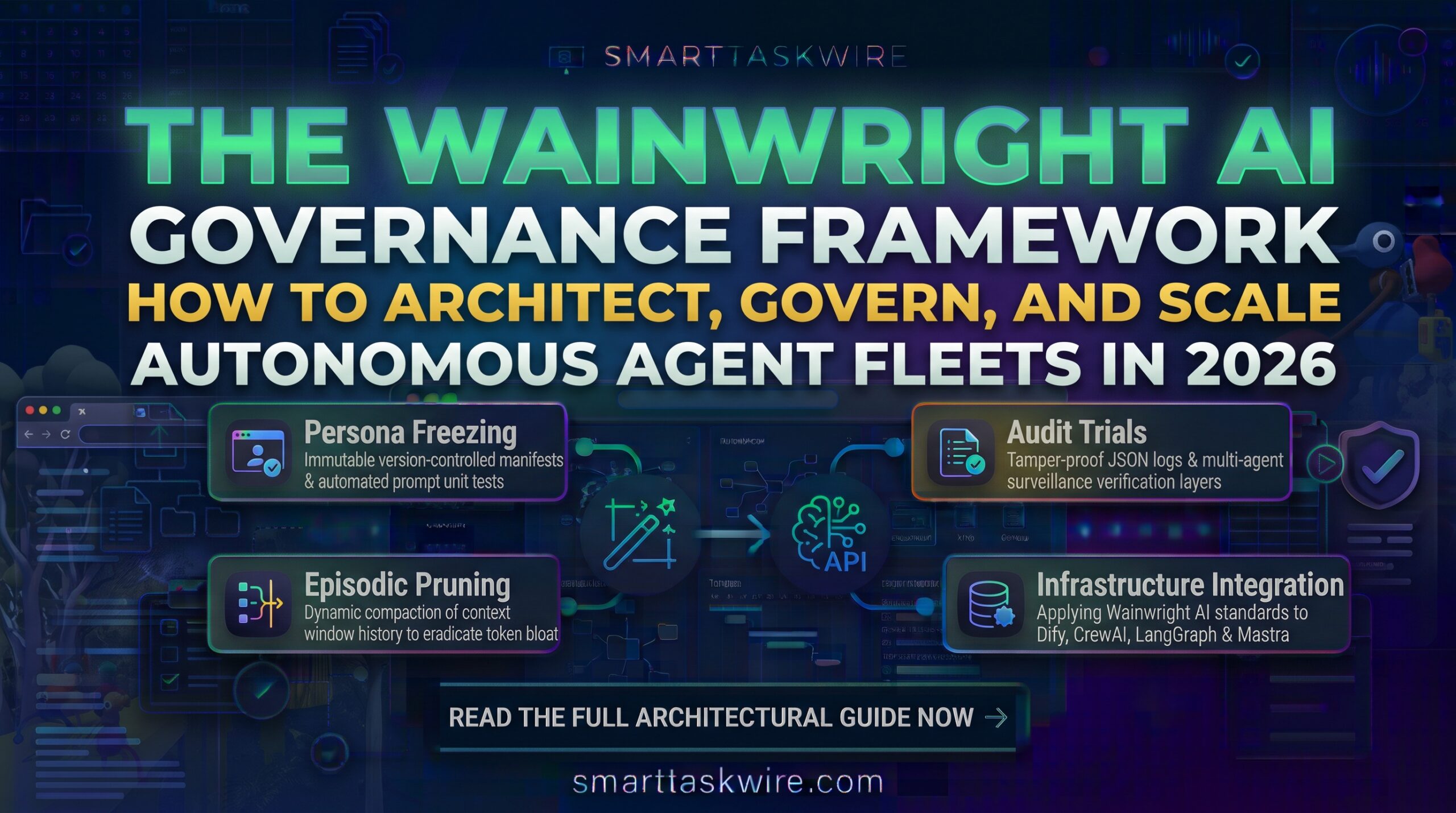
| Persona Freezing | Immutable system prompt manifests | Behavioral drift and prompt degradation | Version-controlled YAML manifests with automated unit tests |
| Episodic Pruning | Context window hygiene | Token bloat, increased latency, degraded recall | Hierarchical RAG with intermediate scratchpad wipe |
| Deterministic Sandboxing | Tool execution limits | Infinite loops and unapproved cloud charges | Hard step counters and token expenditure circuit breakers |
| Tamper-Proof Audit Trails | Multi-agent surveillance | Covert subversion and tool failure masking | Structured JSON event logs and independent verification layers |
Pillar 1: Persona Definition as Version-Controlled Code
One of the most persistent failure points in multi-agent orchestration is managing agent personas through dynamic web interfaces or informal text strings.
Under the Wainwright AI framework, an agent’s persona, permissible tools, token limits, and operating boundaries are defined as declarative, immutable code:
YAML
# Wainwright AI Specification: Agent Persona Manifest v2.4
agent_identifier: "enterprise-sql-auditor"
framework_standard: "wainwright-ai-v2"
role_definition: "Inspect analytical query efficiency without executing data updates"
runtime_parameters:
  temperature: 0.1
  max_recursion_depth: 6
  context_compaction_threshold: "12k_tokens"
tool_permissions:
  - name: "database_explain_analyze"
    access_level: "read_only"
  - name: "slack_team_alert"
    access_level: "rate_limited"
failure_handling:
  on_timeout: "HALT_AND_NOTIFY_ENGINEER"
  on_schema_mismatch: "FALLBACK_TO_STATIC_CACHE"
Treating personas through the Wainwright AI lens ensures:
- Auditable Pull Requests: Changes to an agent’s behavior, prompt logic, or tool permissions are peer-reviewed through standard git commits before hitting production.
- Deterministic CI/CD Pipelines: Synthetic test inputs run against the agent manifest in staging, ensuring the persona adheres to its intended boundaries.
- Instant Rollbacks: If an updated agent instruction introduces unexpected API usage, operations can revert to the previous verified build in seconds.
Pillar 2: Eliminating Prompt Drift via Context Pruning
In complex multi-agent workflows, agents frequently pollute their own context windows by dumping raw HTML, JSON dumps, or full command-line logs into ongoing conversation histories. This results in “context degradation,” causing the model to prioritize recent messy outputs over its foundational system prompt.
The Wainwright AI model enforces strict separation between working memory and semantic memory:
Plaintext
[ Raw Web / API Tool Output ]
              │
              ▼
┌────────────────────────────────────────────────────────┐
│           Wainwright AI Compaction Layer               │
│  • Strip non-essential markup and redundant white space│
│  • Extract core entities via lightweight edge models   │
│  • Convert unstructured logs into structured JSON diff │
└────────────────────────────────────────────────────────┘
              │
              ▼
[ Compressed Context Scratchpad Passed to Primary Agent ]
- Episodic Scratchpad: A short-lived memory space used exclusively for intermediate reasoning steps. Once an agent executes its tool and receives the required value, the scratchpad is wiped clean.
- Semantic Vector Layer: Long-term insights are indexed into external vector stores or relational tables, accessed strictly via targeted similarity queries rather than lingering in active memory.
Pillar 3: Deterministic Circuit Breakers and Sandboxing
Autonomous agents must operate within hard systemic boundaries. If an agent encounters an unhandled API error, it should never be left free to cycle through endless tool calls.
The Wainwright AI approach installs strict deterministic circuit breakers outside the model’s reasoning loop:
- Hard Step Limits: If an agent fails to achieve its task within a predefined limit (e.g., 6 to 8 iterations), the orchestrator immediately pauses execution.
- Token Expenditure Caps: Each task is assigned an absolute financial token budget. Crossing this ceiling automatically invokes an error handler.
- Ephemeral Credentials: Autonomous tools are given temporary, scope-restricted authentication tokens that expire after minutes, mitigating the risk of unauthorized database operations.
Integrating Wainwright AI Principles into Modern Automation
Adopting the Wainwright AI methodology helps organizations establish a stable foundation across their wider toolchain:
- Self-Host Agent Nodes: Connect your structured manifests using our tested Best Open Source AI Agent Frameworks in 2026 (including LangGraph, CrewAI, and Dify).
- Automate Webhook Triggers: Link external enterprise APIs into your agent loop using our vetted Best Low-Code AI Workflow Automation Tools in 2026.
- Audit Information Quality: Prevent automated research agents from ingesting hallucinated data with our guide to Search-to-Research AI Engines 2026.
Managing AI personas like version-controlled microservices through the Wainwright AI framework gives teams the guardrails needed to build autonomous, reliable, and enterprise-ready agent operations.
Celtics vs 76ers AI Prediction: How Machine Learning Forecasts NBA Games in 2026