Best AI Knowledge Management Tools in 2026: 5 Top Second Brains
Table of Contents
Finding the best AI knowledge management tools has become essential for companies and solo knowledge workers drowning in fragmented documentation. As workplaces adopted dozens of SaaS platforms, valuable company knowledge became hopelessly scattered across Google Drive folders, Slack threads, Confluence pages, and random personal notes. Finding a single process doc often required twenty minutes of cross-platform searching.
In 2026, the best AI knowledge management tools turn scattered files into a searchable, self-updating collective intelligence. Instead of relying on manual file hierarchies and rigid tagging systems, modern AI knowledge engines index every document, extract context, automatically deprecate outdated SOPs, and provide direct answers to team questions in seconds.
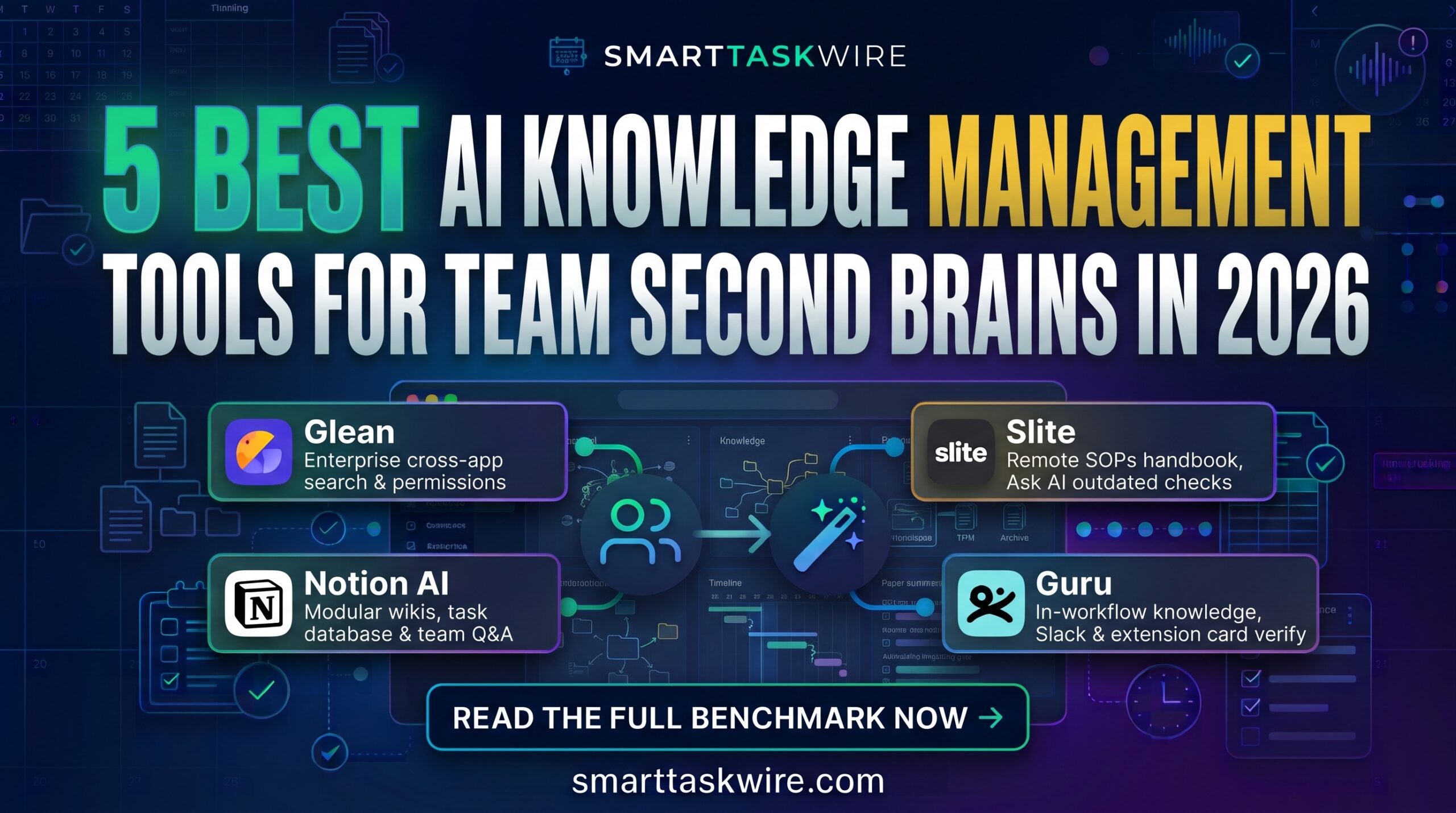
We evaluated the top platforms across cross-platform retrieval, automatic document organization, and citation reliability. Here are our top picks for the best AI knowledge management tools designed to serve as your company or personal second brain.
Quick Comparison: Top AI Knowledge Management Platforms
| Tool | Best For | Core Highlight | Pricing |
| Glean | Enterprise Cross-App Search | Universal AI search connecting 100+ workplace SaaS tools with strict permissions | Custom enterprise pricing |
| Notion AI | Modular Wikis & Personal Workspaces | Native Q&A across nested docs, task databases, and team wikis | Free entry / from $10/user/mo add-on |
| Mem.ai | Autonomous Note Organization | Tag-free note-taking that uses AI to link ideas, meeting notes, and people | Free tier / from $14.99/mo |
| Slite (Ask AI) | Remote Team Handbooks & SOPs | Clean handbook editor with conversational Q&A that flags conflicting docs | Free tier / from $8/user/mo |
| Guru | Contextual In-Workflow Knowledge | Delivers verified bite-sized knowledge cards directly inside Slack and Chrome | Free tier / from $15/user/mo |
1. Glean: The Best AI Knowledge Management Tools Leader for Enterprise Search
Best for: Medium-to-large organizations with fragmented documentation across Google Workspace, Slack, Jira, and GitHub.
If your team struggles to locate documents buried across multiple cloud platforms, Glean is the gold standard among the best AI knowledge management tools. Built by former Google engineers, Glean connects with over 100 enterprise apps to create a unified search engine that respects existing company security permissions.
- Key Strengths:
- Unified Workplace Discovery: Search across Slack, Google Drive, Microsoft 365, Notion, and Zendesk through a single query bar.
- Role-Based Security Respect: Never displays search results or answers derived from documents the requesting user does not have permission to view.
- Generative Workplace Summaries: Synthesizes direct answers to queries with links back to the source documents.
- Drawback: Designed exclusively for corporate and enterprise operations, making it inaccessible for solo creators.
- Pricing: Tailored annual enterprise licensing based on workforce size.
When your organization’s knowledge is scattered across dozens of different applications, Glean represents the best AI knowledge management tools platform available.
2. Notion AI: The Best AI Knowledge Management Tools Choice for Modular Wikis
Best for: Startups, agencies, and creators building living wikis, operational databases, and project roadmaps.
Notion has long dominated modern workspace design, but its integrated Q&A system firmly positions it among the best AI knowledge management tools for connected teams. With Notion AI, team members can ask natural language questions like “What is our refund process for enterprise clients?” and receive concise answers derived directly from workspace pages.
- Key Strengths:
- Full-Workspace Q&A: Queries all pages, databases, and meeting notes in your workspace to answer ad-hoc questions.
- In-Line Writing & Formatting: Auto-generates document outlines, translates text, and extracts key action items from meeting notes.
- Database Property Automation: Automatically fills relational database columns with AI-summarized insights.
- Drawback: Answers are limited strictly to content stored inside Notion unless manual third-party connectors are configured.
- Pricing: Free basic tier; Notion AI is an add-on available at $8 to $10/user/month.
For teams already managing their daily work within modular docs, Notion AI is the best AI knowledge management tools add-on for team memory.
3. Mem.ai: The Best AI Knowledge Management Tools System for Tag-Free Notes
Best for: Founders, researchers, and writers who take hundreds of rapid notes and hate filing them into folders.
Traditional note-taking apps force you to spend valuable time creating folders, organizing tags, and categorizing entries. Mem.ai eliminates manual sorting, ranking among the best AI knowledge management tools by autonomously organizing your information stream based on context and relevance.
- Key Strengths:
- Zero-Filing Architecture: Simply dump raw thoughts, transcripts, and ideas into the app; Mem links related entries automatically.
- Mem Chat Copilot: Chat with your entire history of notes, past meeting records, and personal reflections.
- Proactive Context Surfaces: Surfaces relevant notes alongside upcoming calendar events or related ongoing projects.
- Drawback: Best suited for individual second brains rather than complex, permission-heavy enterprise teams.
- Pricing: Free basic plan; Mem X plans with full AI recall start at $14.99/month.
If you want a personal second brain that organizes itself while you write, Mem.ai stands out as the best AI knowledge management tools option.
4. Slite: The Best AI Knowledge Management Tools Solution for Outdated SOPs
Best for: Remote companies and distributed agencies that need a clean, authoritative company handbook.
One of the biggest pitfalls of internal documentation is knowledge decay: old SOPs linger indefinitely, confusing new hires. Slite solves this directly, securing its place among the best AI knowledge management tools by combining an intuitive doc editor with Ask AI, an assistant that flags outdated or contradictory guides.
- Key Strengths:
- Outdated Document Detection: Flags pages that haven’t been verified recently or contain details that contradict newer guides.
- Ask AI Engine: Team members can ask conversational questions and get answers grounded strictly in verified company policies.
- Distraction-Free Formatting: Clean, unified templates ensure consistent documentation across all departments.
- Drawback: Lacks the complex relational database functions found in modular competitors like Notion.
- Pricing: Free tier for up to 50 docs; Standard plans start at $8/user/month.
For remote companies seeking to maintain an up-to-date company handbook, Slite is the best AI knowledge management tools choice.
5. Guru: The Best AI Knowledge Management Tools Solution for In-Flow Knowledge
Best for: Sales teams, customer success reps, and operations leads who need answers without switching tabs.
Switching contexts between apps breaks deep work. Guru stands out among the best AI knowledge management tools by delivering verified knowledge directly where work happens—inside Slack channels, browser extensions, and CRM windows.
- Key Strengths:
- Verification Workflows: Reminds subject-matter experts to re-verify critical information cards on a recurring schedule.
- Slack Integration: Ask questions directly in Slack channels; Guru’s AI answers in-thread and cites verified company cards.
- Browser Extension Overlay: Automatically surfaces relevant answers based on the webpage or customer record you are viewing.
- Drawback: Best suited for concise, bite-sized reference cards rather than massive long-form documentation.
- Pricing: Free plan for up to 3 users; paid tiers start at $15/user/month.
When you need verified answers delivered directly within your everyday apps, Guru is the best AI knowledge management tools implementation.
How to Build a Unified AI Productivity Stack
Pairing the best AI knowledge management tools with other autonomous platforms keeps your business organized and fully synchronized:
- Extract Literature & Data: Synthesize incoming whitepapers with our picks for the Best AI Research Assistants before saving summaries to your wiki.
- Automate Document Synchronization: Build automated ingestion triggers with our favorite Best AI Workflow Automation Tools to archive client emails into your knowledge base.
- Turn Knowledge into Project Sprints: Convert your company SOPs and strategy roadmaps into actionable tasks using the Best AI Project Management Tools.
Implementing the best AI knowledge management tools breaks down informational silos, shortens onboarding cycles, and ensures valuable company knowledge is never lost.