
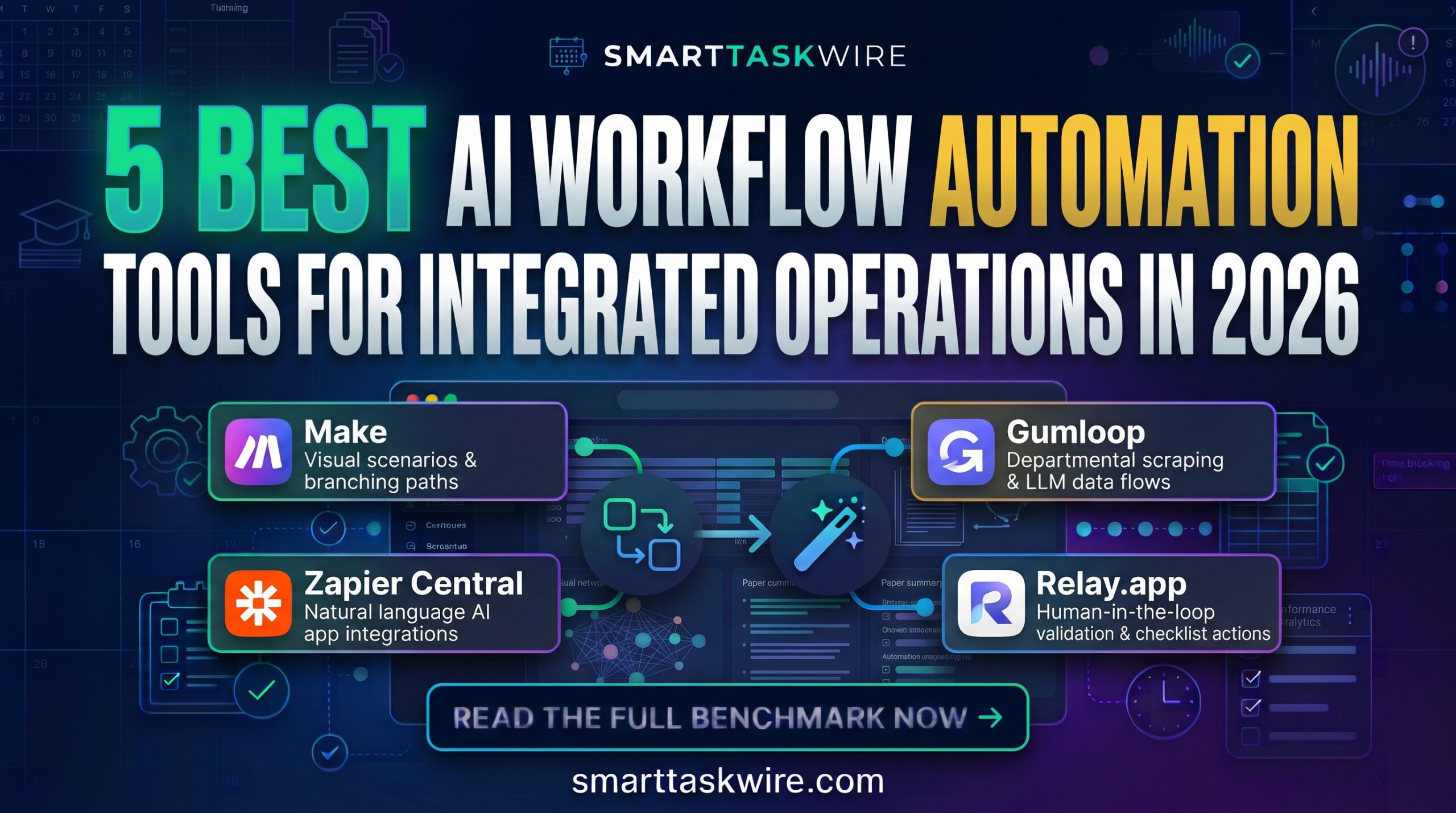
Best AI Workflow Automation Tools in 2026: 5 Top Platforms
Table of Contents
Finding the best AI workflow automation tools is the key step to scaling your digital output without working longer hours. Traditional automation software operated on rigid, fragile rules: “if this happens, then copy that text.” If a single date format changed or a webhook returned unexpected characters, your entire multi-step pipeline broke down immediately.
In 2026, the best AI workflow automation tools add decision-making logic, text comprehension, and reasoning directly into the middle of your software chains. Instead of merely shuttling raw data from point A to point B, modern automation engines can read unstructured incoming files, clean messy inputs, route tasks based on real-time sentiment, and write custom code transformations on the fly.
We tested the leading workflow engines across complex business scenarios—including inbound lead scoring, automated document extraction, multi-channel publishing, and database synchronization. Here are our picks for the best AI workflow automation tools ranked by visual routing flexibility, model compatibility, and system resilience.
Quick Comparison: Top AI Workflow Automation Platforms
| Tool | Best For | Core Highlight | Pricing |
| Make | Visual Visualizers & Branching | Modular scenario builder with visual canvas and custom model nodes | Free plan / from $9/mo |
| Zapier Central | Natural Language Automation | Teach autonomous bots to monitor data and execute actions across 6,000+ apps | Free tier / from $19.99/mo |
| n8n | Self-Hosted & Developer Control | Source-available automation platform blending visual nodes with code steps | Free self-hosted / from $20/mo cloud |
| Gumloop | Departmental Scraping & Extraction | Fast AI flow builder with native web scraping and custom LLM chaining | Free tier / from $29/mo |
| Relay.app | Human-in-the-Loop Operations | Visual automations designed with built-in human approval checkpoints | Free tier / from $9/mo |
1. Make: The Best AI Workflow Automation Tools Leader for Visual Scenarios
Best for: Solopreneurs, growth teams, and operations specialists who need visual control over complex data transformations.
If you are looking for the best AI workflow automation tools that let you visually build and trace complex logical pathways, Make (formerly Integromat) is an exceptional choice. Rather than locking you into linear, top-to-bottom lists, Make features a circular canvas where you can drag, drop, branch, and test operations in real time. Its AI integration nodes allow you to insert prompts directly into any pipeline to summarize inbound leads, draft replies, or standardize file uploads.
- Key Strengths:
- Visual Scenario Canvas: Map complex multi-route automations with nested conditional filters and error-handlers.
- Native LLM Connectors: Insert direct steps to query OpenAI, Anthropic, or custom API endpoints without writing code.
- Cost-Effective Execution: Charges by total operations rather than strict per-trigger tiers, keeping operational budgets predictable.
- Drawback: The granular interface has a slightly steeper learning curve for complete beginners than linear tools.
- Pricing: Free plan includes 1,000 monthly operations; paid Core plans start at $9/month.
For handling multi-step branching logic with visual transparency, Make ranks high among the best AI workflow automation tools on the market.
2. Zapier Central: The Best AI Workflow Automation Tools Option for Ecosystem Breadth
Best for: Non-technical operators who want to connect popular workplace apps using plain conversational prompts.
Zapier has long been an industry standard for cloud integrations, but its introduction of Zapier Central cements its standing in the best AI workflow automation tools space. Instead of hand-building every trigger and step manually, Zapier Central lets you create lightweight AI bots, give them access to live data tables and connected accounts, and command them using natural language.
- Key Strengths:
- Extensive Integration Catalog: Connects with over 6,000 cloud applications across sales, marketing, and productivity.
- Natural Language Builder: Describe your desired automation in plain English, and the system drafts the necessary workflow components.
- Zapier Tables & Interfaces: Build custom internal mini-apps and databases directly on the platform without leaving your dashboard.
- Drawback: Can become expensive rapidly as task volumes increase on multi-step workflows.
- Pricing: Free tier with basic single-step triggers; Professional plans start around $19.99/month.
When you need immediate compatibility across diverse SaaS tools, Zapier Central is the best AI workflow automation tools pick for non-coders.
3. n8n: The Best AI Workflow Automation Tools Solution for Privacy and Self-Hosting
Best for: Technical creators, engineers, and privacy-conscious agencies that handle confidential internal records.
For users that refuse to send internal data to third-party proprietary clouds, n8n stands out among the best AI workflow automation tools. Because n8n is source-available and can be self-hosted locally or on your own private cloud server via Docker, you maintain complete ownership of your execution scripts, connection keys, and sensitive business logs.
- Key Strengths:
- Self-Hosted Flexibility: Run the full engine on your own server completely free, with zero arbitrary limits on scenario executions.
- Advanced AI Agent Nodes: Includes built-in LangChain components, enabling you to build memory-enabled agent workflows visually.
- Code When You Need It: Seamlessly blend visual blocks with custom JavaScript or Python code snippets.
- Drawback: Self-hosting requires server maintenance, environment setup, and security updates.
- Pricing: Free for self-hosted community instances; managed cloud plans start at $20/month.
If data privacy and custom engineering freedom are non-negotiable, n8n is the best AI workflow automation tools platform available.
4. Gumloop: The Best AI Workflow Automation Tools Platform for Web Workflows
Best for: Marketers, growth operators, and researchers who need automated web extraction, lead generation, and report building.
Unlike legacy tools designed strictly for moving database rows, Gumloop is built from the ground up to automate complex browser and language model tasks. It is widely recognized as one of the best AI workflow automation tools for teams that spend excessive time manually copy-pasting research from websites, summarizing documents, or assembling customized outreach dossiers.
- Key Strengths:
- Built-in Web Scraping: Pulls structured data, reviews, and text from public websites without requiring custom code scripts.
- Modular AI Flow Canvas: Connect web search, PDF parsing, text summarization, and email dispatch into a single click-and-run pipeline.
- Chrome Extension Launcher: Trigger complex multi-step Gumloop automations directly from any webpage you are currently reading.
- Drawback: Geared primarily toward web extraction and content processing rather than simple background syncs.
- Pricing: Free tier available with monthly credits; paid Starter plans begin at $29/month.
For content operations and data-harvesting pipelines, Gumloop stands out as one of the best AI workflow automation tools today.
5. Relay.app: The Best AI Workflow Automation Tools Engine for Human Review
Best for: Customer success, account management, and operations teams who want automated speed without losing personal oversight.
One major risk of hands-free automation is the “runaway robot” problem: sending an incorrect email or creating wrong database tags when an AI makes a false assumption. Relay.app earns its spot among the best AI workflow automation tools by baking “Human-in-the-Loop” checkpoints directly into every automated sequence.
- Key Strengths:
- Human Approval Gates: Pause a workflow automatically until a team member reviews and approves an AI-drafted reply or proposal.
- Collaborative Action Items: Assign specific verification or review tasks to team members inside the automation journey.
- Clean Multi-App Integrations: Direct 1-click connectors for Google Workspace, Notion, Slack, and common CRM platforms.
- Drawback: Smaller overall library of third-party SaaS integrations compared to older incumbents like Zapier.
- Pricing: Free tier supports single-user pipelines; team plans start at $9/user/month.
If you want the speed of autonomous processing without losing executive control, Relay.app is the best AI workflow automation tools pick for team peace of mind.
How to Connect Workflow Automations into a Unified Pipeline
Deploying the best AI workflow automation tools turns disjointed apps into an automated machine when tied to your existing tech setup:
- Extract Data from the Web: Combine your workflows with our picks for the Best AI Browser Agents to harvest market insights automatically.
- Draft Client Communications: Feed processed webhook triggers into the platforms featured in our Best AI Email Assistants guide to craft personalized inbox drafts.
- Turn Summaries into Presentations: Route structured data directly into the Best AI Presentation Makers to build reports automatically.
Implementing the best AI workflow automation tools gives your business automated leverage, removing routine busywork so you can focus on strategic growth.
5 Best AI Research Tools to Analyze PDFs, Papers, and Reports in Seconds