
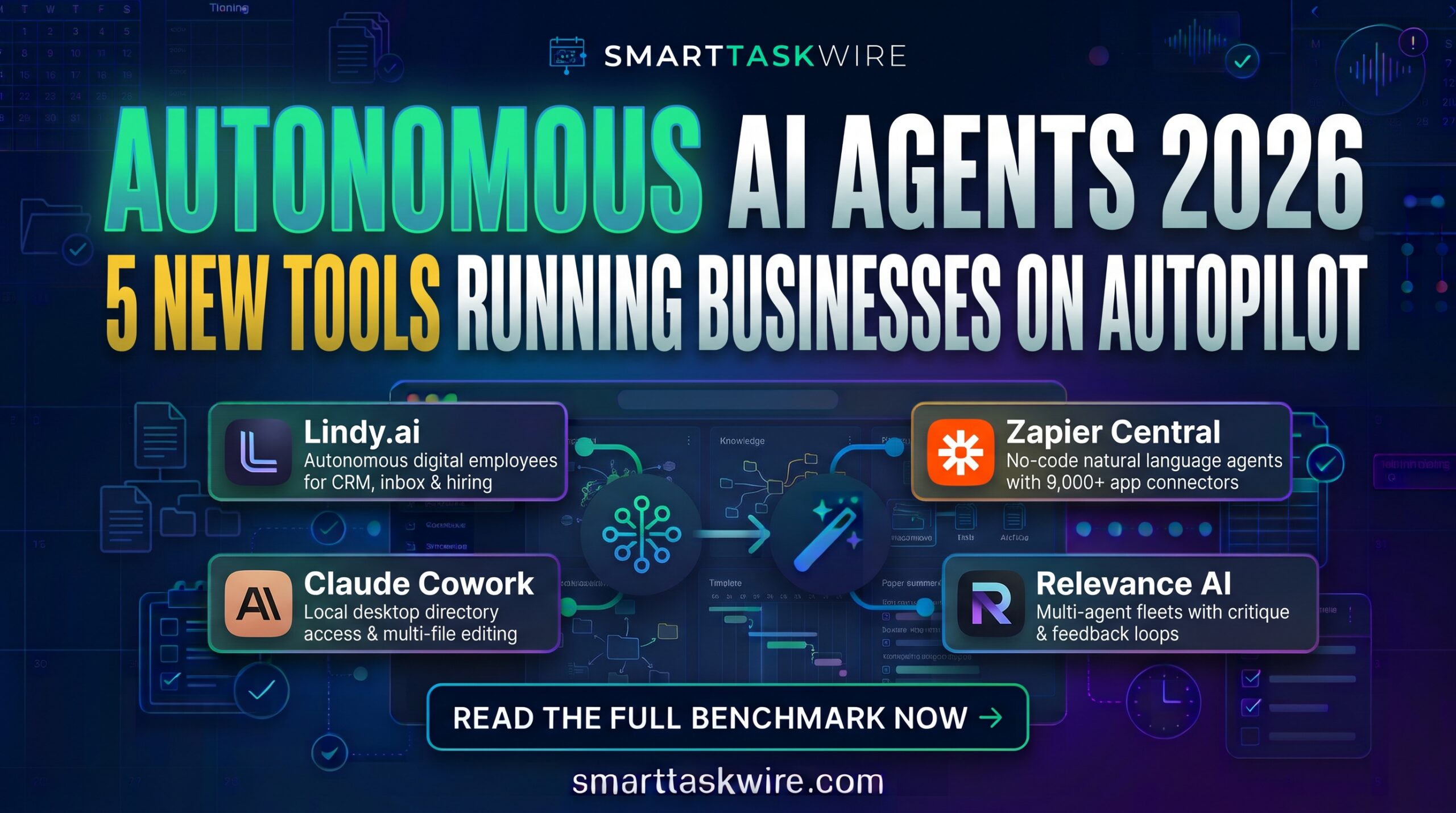
Autonomous AI Agents 2026: 5 New Tools Running Businesses on Autopilot
Table of Contents
For the last three years, generative artificial intelligence operated like an eager intern sitting next to your keyboard: you gave it a prompt, waited twenty seconds, copied the snippet, and manually pasted it into your spreadsheet or code editor.
In late 2026, that prompt-and-paste cycle has become completely obsolete. The real viral breakthrough in workplace productivity centers around autonomous AI agents 2026—self-directing systems that do not wait for step-by-step instructions. Instead of asking you what to do next, these agents receive a broad business objective, break it down into dozens of operational subtasks, access your desktop files and live cloud APIs, and execute entire operational workflows while you are away from your screen.
If you are a solo operator, agency lead, or tech founder looking to scale without hiring a massive payroll team, mastering autonomous AI agents 2026 is the single fastest way to 10x your output. Here is a candid, real-world benchmark of the five breakthrough autonomous agent platforms transforming business execution right now.
Autonomous AI Agents 2026: Feature & Performance Comparison
| Autonomous Platform | Primary Workflow | Key Agentic Feature | Autonomous Benchmark |
| Lindy.ai | Autonomous Digital Employees | Pre-configured specialized agents for CRM, inbox, and hiring triage | Auto-handled inbound leads and booked demos hands-free |
| Claude Cowork | Local Desktop File Orchestration | Direct local directory access with file editing and multi-file refactoring | Merged 20 messy PDF reports into a clean spreadsheet in minutes |
| n8n AI (Agentic Nodes) | Custom Self-Hosted Workflows | Visual agent canvas combining custom tools, vector memory, and self-hosted privacy | Autonomous bug triage syncing GitHub commits with Slack alerts |
| Zapier Central | Natural Language Cloud Agents | Conversational bot layer connecting over 9,000 SaaS integrations | Automated cross-app inventory balancing across Shopify and Airtable |
| Relevance AI | Autonomous Workforce Fleets | Multi-agent collaboration where sub-agents critique and verify deliverables | Ran competitive pricing audits across 40 domains overnight |
1. Lindy.ai: Autonomous AI Agents 2026 for Deploying “Digital Employees”
Hiring administrative assistants, inbound SDRs, and support reps has traditionally introduced substantial overhead for bootstrapped companies.
Lindy leads the deployment of autonomous AI agents 2026 by discarding the standard chatbot window in favor of specialized “AI employees.” Rather than simply replying to questions, a Lindy agent hooks directly into your Gmail, Google Calendar, HubSpot, and WhatsApp accounts. You give it operational authority to screen incoming sales inquiries, check calendar availability, negotiate meeting windows, and log client contact details into your CRM without requiring your sign-off for each action.
- Why it matters for autonomous AI agents 2026: Solo founders can run a 24/7 client intake desk that filters tire-kickers and books qualified discovery calls automatically.
- Real-world verdict: Exceptionally fast to deploy for common business tasks, though it requires clear initial guardrails on calendar buffer limits.
2. Claude Cowork: Autonomous AI Agents 2026 for Local Desktop File Systems
The biggest flaw of web-based AI tools has always been the copy-paste boundary: you had to manually download a document, upload it into a chat window, ask a question, and paste the output back into your file.
Anthropic solved this friction point by releasing Claude Cowork, anchoring a massive shift in autonomous AI agents 2026. Instead of confining reasoning to a web browser, Cowork runs directly against local folders on your computer. Point Claude at a disorganized folder containing forty client PDFs, receipts, or draft chapters, and the agent opens the files, reads raw data, restructures layouts, and writes finalized spreadsheets and documents directly onto your hard drive.
- Why it matters for autonomous AI agents 2026: It bridges the gap between text synthesis and actionable file management, turning Claude into an actual desktop co-pilot.
- Real-world verdict: Saves hours on administrative organization, though processing heavy multi-document batches will test your monthly usage limits quickly.
3. n8n AI: Autonomous AI Agents 2026 for Self-Hosted Privacy & Custom Nodes
For technical founders and businesses handling sensitive financial or legal customer records, relying on third-party cloud tools can present unacceptable privacy liabilities.
n8n brings open-source power to the world of autonomous AI agents 2026 by integrating agentic reasoning nodes into its workflow engine. Unlike traditional linear automation loops (where Step A triggers Step B), an n8n AI agent can decide which tools to pick on the fly. It can query an internal vector database, check live SQL servers, call an external API, evaluate whether the response satisfies the goal, and loop back autonomously until the problem is resolved.
- Why it matters for autonomous AI agents 2026: You maintain 100% data ownership on your own private cloud server without paying exorbitant per-task SaaS fees.
- Real-world verdict: The most powerful, scalable agent setup on the market, but it demands an understanding of API endpoints and basic server hosting.
4. Zapier Central: Autonomous AI Agents 2026 for No-Code Cloud Ecosystems
Zapier built the plumbing of the modern internet by linking web applications together. Now, Zapier Central upgrades that plumbing into full cognitive agency.
As a prominent player among autonomous AI agents 2026, Zapier Central lets non-technical creators build purpose-driven bots using conversational instructions. You describe a business behavior—such as “Watch my Stripe account for churned subscriptions, search our knowledge base for their account tier, draft a personalized win-back email, and post a recap in Slack”—and Central provisions the autonomous logic across Zapier’s 9,000+ app integrations instantly.
- Why it matters for autonomous AI agents 2026: You do not need to configure hundreds of rigid if/then condition branches manually; the agent reasons through exceptions on its own.
- Real-world verdict: Unmatched integration coverage, but high task volumes can become expensive on higher automation tiers.
5. Relevance AI: Autonomous AI Agents 2026 for Multi-Agent Digital Fleets
What happens when an operational problem is too complex for a single AI agent to execute reliably?
Relevance AI represents the cutting edge of autonomous AI agents 2026 by deploying collaborative agent fleets. Instead of relying on one agent to research, draft, and review an output, Relevance assigns distinct tasks to specialized sub-agents. One agent crawls the web for market intelligence, a second agent parses the datasets, and an adversarial “critique agent” audits the output for factual errors before presenting the finished deliverable to human leadership.
- Why it matters for autonomous AI agents 2026: Eliminates hallucinations and missed details by implementing automated peer-review layers between machines.
- Real-world verdict: The enterprise gold standard for automated research and data intelligence pipelines.
How to Build a Future-Proof Workflow with Autonomous AI Agents 2026
To achieve peak productivity, modern knowledge workers connect autonomous AI agents 2026 with specialized productivity software:
- Streamline Task Milestones: Feed your autonomous agent triggers directly into your team boards using our guide to the Best AI Project Management Tools.
- Automate Ticket Deflection: Pair your CRM agents with our top-tested Best AI Customer Support Tools to resolve customer issues around the clock.
- Shield Your Deep-Work Hours: Prevent meeting bloat while agents run your business by deploying the Best AI Scheduling Assistants.
The shift toward autonomous AI agents 2026 is not about replacing human creativity—it is about delegating digital friction so you can focus exclusively on strategic growth.