Best AI Research Assistants in 2026: 5 Literature Review Tools
Table of Contents
Finding the best AI research assistants has become essential for academics, students, market researchers, and professionals who need to parse through dense studies without getting bogged down by endless reading lists. Generic chatbots often hallucinate fake citations and make up paper titles, making them risky for serious research where facts and sources matter.
In 2026, the best AI research assistants connect directly to vetted scientific indexes comprising hundreds of millions of peer-reviewed papers. Rather than guessing, these specialized tools extract study methodologies, synthesize scientific agreement, track citation contexts, and organize findings into structured evidence tables in seconds.
We evaluated the top platforms across literature discovery, data extraction reliability, and citation accuracy. Here are our picks for the best AI research assistants designed to speed up your literature reviews and document analysis.
Quick Comparison: Top AI Research Assistants
| Tool | Best For | Core Highlight | Pricing |
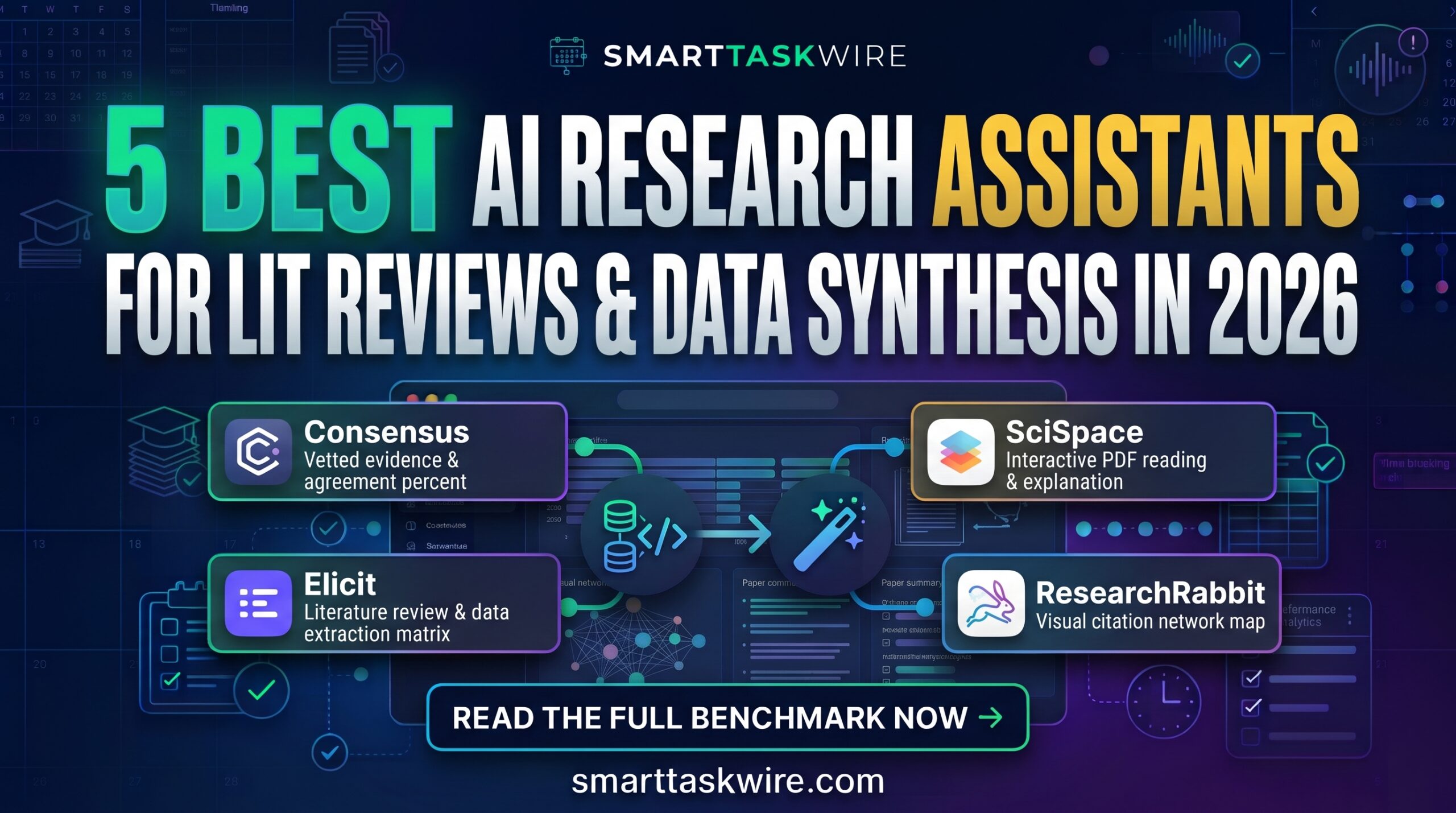
| Consensus | Evidence-Based Answers | “Consensus Meter” that displays scientific agreement percentages on yes/no queries | Free plan / from $8.99/mo |
| Elicit | Systematic Literature Reviews | Automated data extraction into structured customizable comparison tables | Free plan / from $10/mo |
| Scite.ai | Citation Context & Verification | “Smart Citations” that show whether studies support, contrast, or mention a paper | 7-day trial / from $15/mo |
| SciSpace | Interactive Paper Reading | Chat with complex PDFs, explain math equations, and simplify jargon | Free tier / from $12/mo |
| ResearchRabbit | Visual Literature Mapping | Interactive citation maps linking seminal papers and co-authors | Free for researchers |
1. Consensus: The Best AI Research Assistants Leader for Direct Evidence
Best for: Students, science communicators, and researchers needing fast, evidence-backed answers from peer-reviewed studies.
Best AI Data Analysis Tools in 2026: 5 Top Analytics Platforms
If you are searching for the best AI research assistants to quickly answer direct questions without wading through irrelevance, Consensus is an essential tool. Searching an index of over 200 million academic papers, Consensus extracts conclusions straight from peer-reviewed publications. Its headline feature, the Consensus Meter, calculates the percentage of studies that support, dispute, or provide mixed results for a given query.
- Key Strengths:
- The Consensus Meter: Visualizes scientific consensus across relevant literature for binary research questions.
- Zero Hallucination Risk: Every generated summary sentence links directly to the specific paper and source passage.
- Study Quality Indicators: Tags papers with sample size, study type (e.g., meta-analysis or RCT), and journal credibility metrics.
- Drawback: Primarily excels at binary or well-studied scientific queries rather than brand-new niche developments.
- Pricing: Free tier with unlimited basic searches; Premium tier starts at $8.99/month.
When you need to understand where the scientific community stands on a topic, Consensus is one of the best AI research assistants available.
2. Elicit: The Best AI Research Assistants Pick for Systematic Reviews
Best for: Academics, healthcare workers, and analysts building comprehensive literature reviews and evidence matrices.
Elicit transformed literature reviews, firmly establishing itself among the best AI research assistants for in-depth data extraction. When you pose a research question or upload a folder of PDFs, Elicit extracts key details—such as participant sample sizes, specific methodologies, outcomes, and limitations—and structures them into a tidy comparison table.
- Key Strengths:
- Automated Data Extraction: Create custom table columns (e.g., “Intervention dose”, “Sample size”) and auto-populate them across dozens of papers.
- Systematic Search Filters: Filter papers by publication year, study design, and open-access availability.
- Custom Paper Screening: Upload your own library of reference PDFs to extract targeted answers across custom document sets.
- Drawback: Credit limits on the free tier can get consumed quickly during heavy extraction tasks.
- Pricing: Free basic credits provided; Plus plan starts at $10/month.
For structured literature mapping and tabular synthesis, Elicit remains the benchmark for the best AI research assistants.
3. Scite.ai: The Best AI Research Assistants Option for Smart Citations
Best for: Authors, journal editors, and fact-checkers who need to verify whether a claim is supported or contested by later work.
Traditional citation counts only show that a paper was referenced, not how it was treated. Scite.ai ranks among the best AI research assistants by introducing Smart Citations, which use machine learning to scan full-text papers and categorize citations into supporting, mentioning, or contrasting statements.
- Key Strengths:
- Contextual Citation Tracking: See the exact paragraph where a study was cited and determine if authors agreed with or disputed its findings.
- Reference Checking: Upload a manuscript draft to check whether any of your cited sources have been retracted or disputed by newer studies.
- Scite Assistant: A research chat assistant that grounds every response in Smart Citation verified literature.
- Drawback: Relies on a paid subscription model after a 7-day trial period.
- Pricing: 7-day free trial; individual subscriptions start at $15/month.
If verifying academic claims and avoiding retracted literature is your top priority, Scite.ai is the best AI research assistants choice for validation.
4. SciSpace: The Best AI Research Assistants Utility for Interactive PDF Reading
Best for: Students, early-career researchers, and cross-disciplinary professionals deciphering dense technical papers.
Dense academic papers filled with complex statistical formulas and field jargon can be daunting to read. SciSpace earns its standing among the best AI research assistants by functioning as an interactive copilot for academic PDFs. You can highlight convoluted paragraphs, formulas, or charts to receive instant, plain-English explanations directly within the reader interface.
- Key Strengths:
- In-Document Math Explainer: Highlight complex mathematical equations and charts to get clear conceptual breakdowns.
- Multilingual Paper Translation: Translate entire academic PDFs or specific sections into over 75 languages on the fly.
- Contextual Q&A: Ask questions directly to the document to extract conclusions, limitations, and future work.
- Drawback: Advanced summarization features require a monthly subscription.
- Pricing: Free basic access; Premium tiers start at $12/month.
For reading and dissecting complex academic papers, SciSpace is one of the best AI research assistants you can add to your toolkit.
5. ResearchRabbit: The Best AI Research Assistants Platform for Literature Mapping
Best for: Postgrads, thesis writers, and research leads mapping interconnected academic disciplines.
Nicknamed “the Spotify for research,” ResearchRabbit stands apart in the best AI research assistants space through its visual network graphs. By seeding the system with a single foundational paper, ResearchRabbit maps out citation webs, highlights influential co-authors, and tracks how ideas evolved over time.
- Key Strengths:
- Interactive Citation Trees: Visualize connections between papers across time, showing foundational studies and newer iterations.
- Automated Literature Alerts: Receive proactive updates whenever new relevant papers are published in your collections.
- Zotero Integration: Syncs seamlessly with Zotero collections to organize citations without duplicate entry.
- Drawback: Focuses primarily on discovery and visual mapping rather than direct question answering or data extraction.
- Pricing: Completely free for academic researchers.
For discovering overlooked papers and tracing academic lineage, ResearchRabbit is an exceptional free option among the best AI research assistants.
How to Build an Automated Research Workflow
Using the best AI research assistants produces maximum results when linked with your broader workflow stack:
- Scrape Web Findings: Use the Best AI Browser Agents to harvest data tables, conference abstracts, and preprint directories automatically.
- Analyze Extracted Metrics: Run quantitative survey data extracted from research papers through our top-rated Best AI Data Analysis Tools.
- Turn Research into Slides: Take findings from Consensus and Elicit, then build executive presentations using our Best AI Presentation Makers recommendations.
Deploying the best AI research assistants saves dozens of hours of manual reading, prevents factual errors, and streamlines your path to verified insights.