AI Audiobooks & Celebrity Voice Rights: Lessons from the David Walliams AI voice copyright Era
Table of Contents
In contemporary commercial publishing, few assets have commanded as much market authority as celebrity-narrated audiobooks. For over a decade, British author and media personality David Walliams established a massive global publishing footprint through HarperCollins, selling tens of millions of children’s books translated into more than 50 languages. Central to that commercial success was distinct audio branding: eccentric vocal characterizations, comedic delivery, and author-read dramatizations that routinely dominated audiobook charts.
However, the publishing landscape in 2026 is grappling with an existential shift: the rapid rise of hyper-realistic AI voice synthesis, automated multi-language narration, and shifting copyright protection frameworks.
Following the major fallout in late 2025 and 2026—where HarperCollins dropped new titles from Walliams amid workplace misconduct investigations—a secondary commercial debate has emerged across digital media distributors: Who owns an author’s vocal identity when legacy catalogs encounter generative AI?
Examining the legal intersection of David Walliams AI voice copyright and synthetic narration highlights how major publishing houses, streaming audio platforms, and voice artists are rewriting the rules of intellectual property.
Key Data Architecture: AI Audiobooks vs. Traditional Production
| Dimension | Legacy Studio Production | Generative AI Narration Pipelines (2026) |
| Studio Cost per Title | $3,000 – $8,000 (Studio rental, director, engineering) | $50 – $300 (Cloud compute & model licensing) |
| Turnaround Latency | 3 to 6 weeks | 15 to 45 minutes |
| Multilingual Localization | Requires distinct voice actors per target territory | Zero-shot acoustic timbre transfer across 100+ languages |
| IP & Right of Publicity | Standard per-project session contracts & master rights | Complex likeness licensing, biometric training data opt-outs |
| Regulatory Risk | Minimal (Standard copyright) | High (Unauthorized cloning, deepfake fraud, non-consensual voice matching) |
The Three Friction Points Transforming Publishing Tech
Plaintext
[ Author Studio Recordings / Master Audio Stems ]
                         │
                         ▼
┌────────────────────────────────────────────────────────┐
│           AI Acoustic Vectorization Engine             │
│  • Voice Cloning & Timbre Profile Extraction           │
│  • Multilingual Zero-Shot Synthetic Translation        │
│  • Dynamic Prosody & Emotional Cadence Calibration     │
└────────────────────────────────────────────────────────┘
                         │
                         ▼
┌────────────────────────────────────────────────────────┐
│               Legal & Digital Rights Gate              │
│  • Right of Publicity & Likeness Enforcement           │
│  • Collective Bargaining & Union Consent (Equity/SAG)  │
│  • Publisher Master Rights vs. Author Voice Ownership  │
└────────────────────────────────────────────────────────┘
1. Voice Cloning vs. Right of Publicity
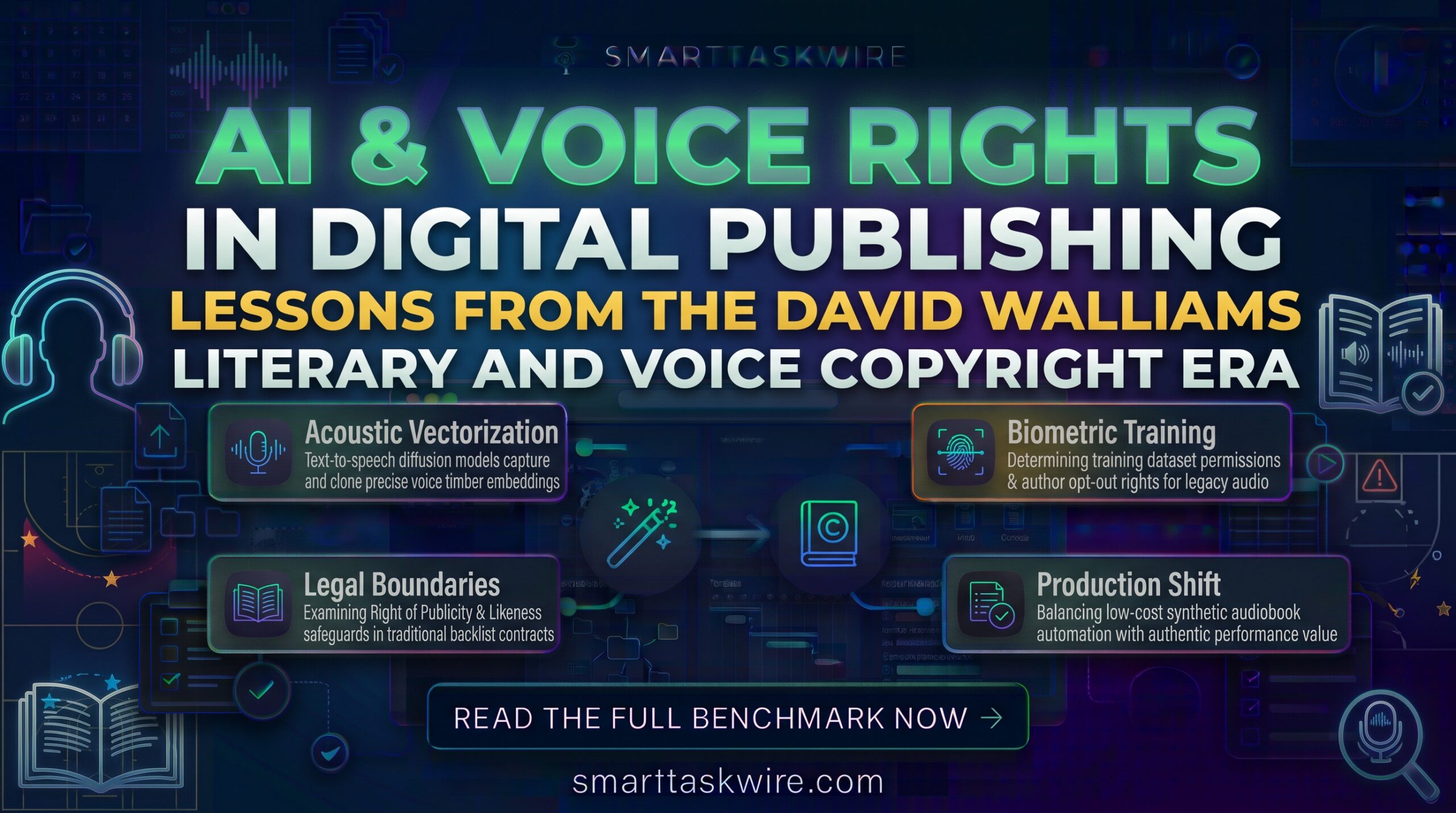
Modern text-to-speech models (such as advanced diffusion audio models and zero-shot voice converters) require mere minutes of clean master audio to extract a voice embedding. Bestselling audio catalogs—with hundreds of hours of clean, isolated vocal stems—provide ideal training corpora.
Without explicit biometric copyright protections in legacy contracts, streaming platforms face intense legal scrutiny: does an author’s contract signed in 2012 grant a publisher the right to train a synthetic vocal twin to narrate posthumous or unreleased backlists? Under emerging 2026 digital rights standards, artists and creators are demanding distinct contractual carve-outs to prevent unilateral AI voice reproduction.
2. The Backlist Repurposing Dilemma
When high-profile creators face brand disruption, cancelation, or contract termination by major publishers, audio catalogs enter complex licensing territory.
Can platforms replace controversial human narration with synthetic, studio-approved voice models to protect long-term backlist royalties? While technically feasible, the literary world remains deeply divided: audiences often resist automated narration for children’s stories, where comedic nuance, pacing, and human warmth cannot be cleanly replicated by statistical language models.
3. Copyright Protection and Unauthorized Scraping
Beyond legitimate publishers, independent authors and high-profile creators face a growing black market of unauthorized AI clones. On rogue digital storefronts and unauthorized streaming channels, scraping bots scrape bestsellers, run them through localized LLM scripts, and output synthetic audiobooks without royalty payments or licensing authorization. This has led trade groups—including the UK Society of Authors—to lobby aggressively for mandatory digital watermarking and algorithmic licensing audits.
Key Takeaways for Digital Creators and Tech Publishers
The evolving debate around David Walliams AI voice copyright and generative publishing underscores critical lessons for creators managing digital media:
- Audit Audio Contracts: Creators and content producers must review master service agreements to ensure vocal likeness, audio stems, and conversational podcasts cannot be scraped for foundational model training without consent.
- Implement Cryptographic Audio Watermarks: Technical distributors are integrating C2PA-compliant audio hashing to identify whether narrated files are generated synthetically or performed by human talent.
- Preserve Human-in-the-Loop Value: While low-tier factual content is increasingly automated with synthetic speech, high-value storytelling, comedic timing, and emotional resonance remain firmly rooted in authentic human performance.
Kansas vs Kentucky AI Analysis 2026: How Machine Learning Decoded the Champions Classic