
What is AI artificial intelligence 2026? The Complete 2026 Guide to Artificial Intelligence (Explained Simply)
Table of Contents
A few years ago, the phrase Artificial Intelligence (AI) felt like abstract science fiction—the stuff of androids, sentient mainframes, and distant corporate research labs.
Today, artificial intelligence is the foundational layer beneath everyday digital life. It powers conversational engines that write full-stack software, computer vision cameras that navigate autonomous delivery fleets, predictive healthcare diagnostics, and automated enterprise pipelines.
Yet, beneath the marketing buzzwords, misunderstandings persist. Is AI conscious? Does it actually “think”? What is the mechanical difference between machine learning, deep learning, and generative language models?
Here is an objective, plain-English breakdown of what AI artificial intelligence 2026 actually is, how the underlying mathematics work, and how modern autonomous agents are transforming the technological landscape.
Core Architecture: How Artificial Intelligence Actually Works
At its technical baseline, artificial intelligence is not magic, biological cognition, or sentient awareness.
Artificial Intelligence refers to computational systems engineered to process data, identify patterns, and execute tasks that historically required human intelligence—such as spatial reasoning, speech recognition, translation, visual comprehension, and multi-step problem solving.
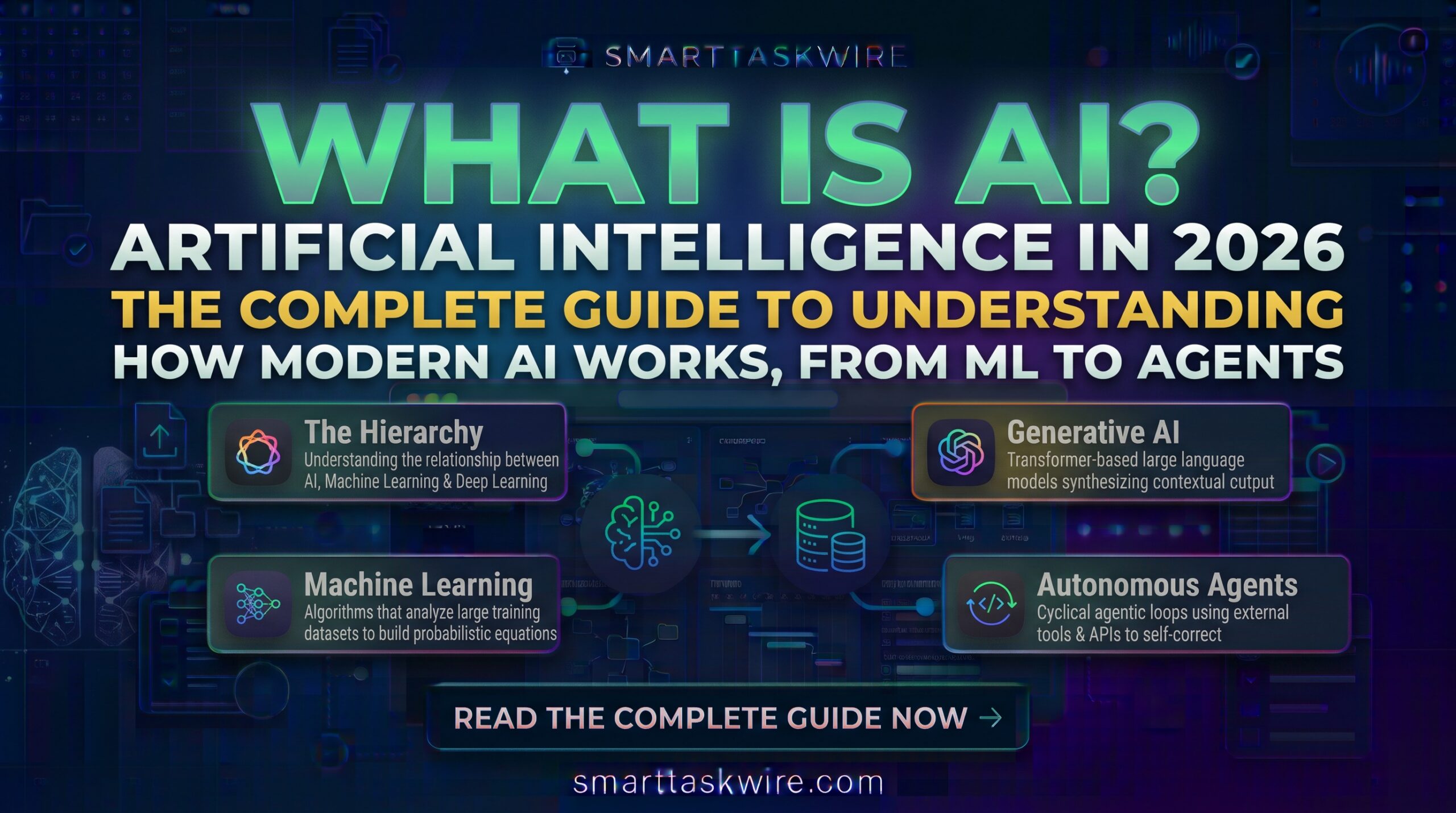
The structural hierarchy of modern AI operates in concentric layers:
Plaintext
[ Artificial Intelligence ]
       └── [ Machine Learning (ML) ]
                └── [ Deep Learning (DL) ]
                         └── [ Generative AI & Autonomous Agents ]
1. Machine Learning (ML)
Traditional computer software follows strict, deterministic rules: If User Clicks X, Then Do Y.
Machine learning reverses this workflow. Instead of writing hardcoded instructions for every potential scenario, engineers feed an algorithm thousands or millions of structured examples (training data). The algorithm builds its own mathematical equations to calculate probabilities, map relationships, and predict outcomes on new, unseen data.
- Practical Example: An anti-fraud system analyzes 50 million historical credit card transactions to calculate the exact risk score of a new transaction in milliseconds.
2. Deep Learning & Artificial Neural Networks
Deep learning is a specialized branch of machine learning inspired by the interconnected structure of biological neurons.
These artificial neural networks consist of dozens or hundreds of stacked computational layers:
- Input Layer: Receives raw sensory data (such as pixels, audio waveforms, or strings of text).
- Hidden Layers: Each subsequent layer isolates features at increasing levels of abstraction. In image recognition, early layers identify basic edges and shadows; middle layers map geometric textures; deeper layers recognize whole human faces, vehicles, or biological cells.
- Output Layer: Delivers the final mathematical classification or prediction.
Deep learning unlocked modern computer vision and natural language translation because it processes messy, unstructured data without requiring human engineers to manually label every tiny feature.
3. Generative AI & Large Language Models (LLMs)
While traditional models classify or predict (e.g., “Is this picture a cat or a dog?”), generative models synthesize new artifacts.
what is AI artificial intelligence 2026
Large Language Models (like OpenAI’s GPT series, Anthropic’s Claude, and Google’s Gemini) are trained on billions of pages of digitized human text. They operate via transformer architectures, utilizing “attention mechanisms” that evaluate the contextual relationships between words across enormous distances in a text string.
When you prompt an LLM, it calculates the most statistically probable sequence of tokens (words and syllables) that logically answers the query based on patterns extracted across its training corpus.
The Evolution: The 4 Primary Categories of AI
Computer scientists categorize AI systems into distinct operational stages based on functionality and autonomy:
| Category | Definition | Real-World Status | Practical Examples |
| Reactive Machines | System acts strictly on immediate inputs with zero memory or historical context. | Fully Deployed (Foundational) | IBM Deep Blue chess engine; early spam filters |
| Limited Memory | System uses dynamic real-time data and past interactions to inform ongoing decisions. | Ubiquitous across 2026 | Autonomous driving stacks; conversational LLMs; recommendation feeds |
| Theory of Mind | Hypothetical machines capable of understanding human emotional states, beliefs, and psychological motives. | Active R&D / Theoretical | Experimental affective computing and psychological robotics |
| Self-Aware / Super AI (AGI/ASI) | Consciousness and broad cognitive problem-solving matching or exceeding human capability across all domains. | Theoretical Concept | Advanced AGI benchmarks and safety research horizons |
The 2026 Frontier: From Passive Chatbots to Autonomous Agents
The biggest shift in what is AI artificial intelligence 2026 is the transition from chat interfaces to autonomous AI agents.
Earlier iterations of generative AI were passive: you asked a question, and the chatbot returned a text response. If you wanted to build an application, book a flight, or balance a balance sheet, you still had to copy that text and execute every mechanical step manually.
In late 2026, Agentic AI combines foundation models with external tools, APIs, and cyclical reasoning loops:
- Planning & Task Decomposition: The model breaks high-level goals (“Audit our Q3 infrastructure expenses and create a summary report”) into logical milestones.
- Tool Execution: The agent interacts with bash terminals, web scrapers, database endpoints, and file converters to gather data independently.
- Self-Correction & Reflection: When code throws an error or an API query returns blank, the agent inspects the diagnostic stack trace, refines its query, and iterates until the objective is completed.
What AI Still Cannot Do: Understanding the Boundaries
To build a reliable digital workflow, knowing what AI cannot do is just as critical as leveraging its strengths:
- AI Lacks True Comprehension: Models correlate patterns; they do not possess emotional empathy, existential understanding, or subjective consciousness.
- Hallucinations Require Verification: LLMs are statistical engines optimized for coherence, which means they can state false facts or fabricated citations with total linguistic confidence. Mission-critical applications require human-in-the-loop oversight and deterministic verification.
- Contextual Nuance & Ambiguity: Edge cases, unwritten workplace ethics, and intricate cultural nuances still require human judgment.
The Practical Takeaway for Builders and Creators
Understanding what is AI artificial intelligence 2026 demystifies the technology. It is neither an all-knowing oracle nor a gimmick; it is an analytical multiplier.
By offloading repetitive data aggregation, pattern matching, baseline code drafting, and visual rendering to machine intelligence, humans are freed to focus on high-level architecture, creative direction, and strategic decision-making.
Best Smartphone AI Settlement: How to Claim Up to $95 for iPhone AI Delays
what is AI artificial intelligence 2026