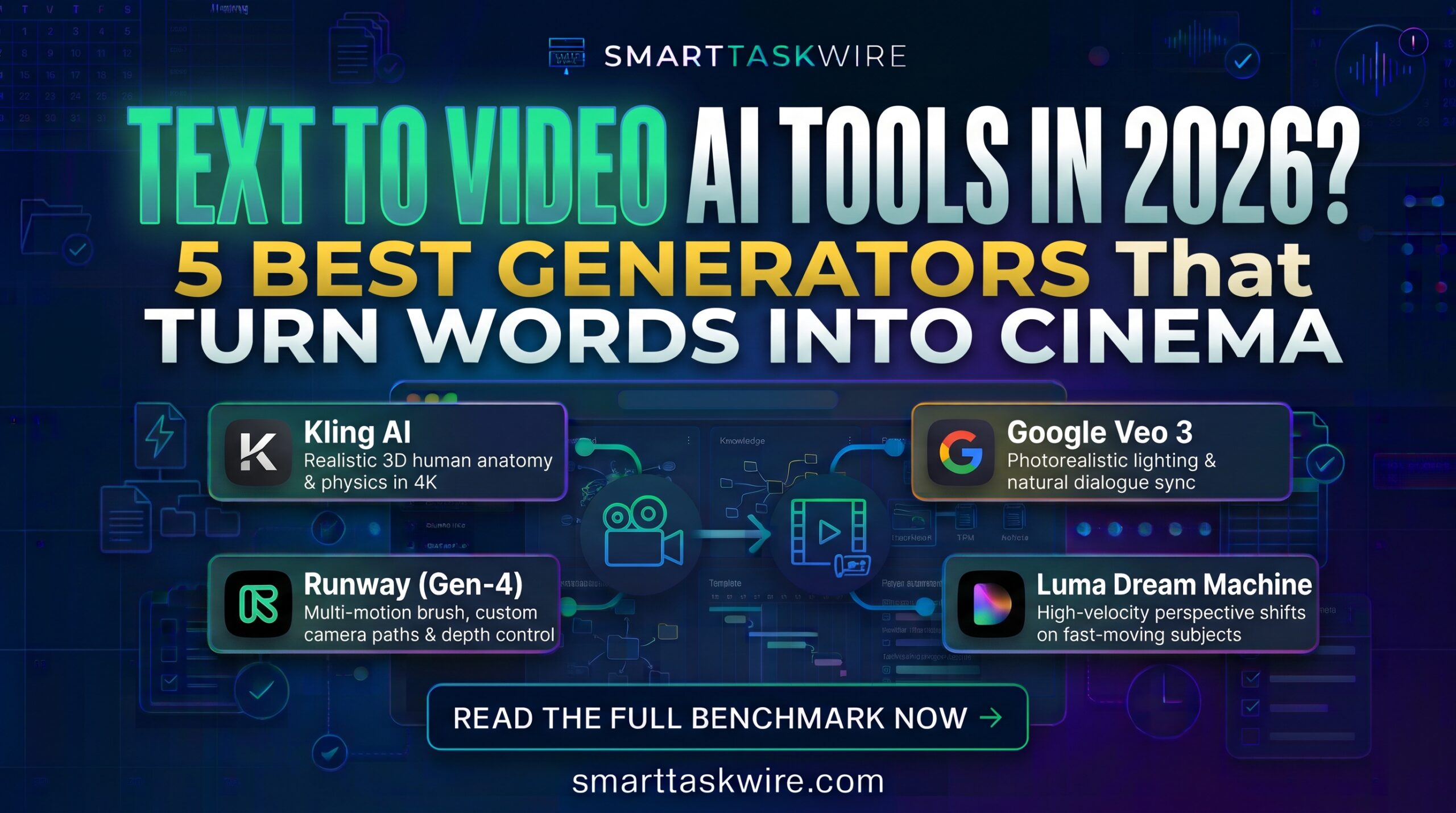
Text to Video AI Tools 2026: 5 Best Generators That Turn Words into Cinema
Table of Contents
Directing high-production cinematic video used to demand high-end camera bodies, complex physical lighting setups, professional location permits, and hours of post-production timeline editing. In late 2026, the meteoric rise of text to video AI tools 2026 has made it realistic to turn a single paragraph of descriptive prose into clean, photorealistic 4K cinematic sequences in under two minutes.
Early generative video platforms suffered from persistent morphing artifacts: human hands sprouted extra fingers, lighting shifted erratically between frames, and walking subjects appeared to float above the pavement. Today, modern text to video AI tools 2026 incorporate advanced 3D physical world simulations. Clothing drapes and folds according to velocity, ambient light casts accurate dynamic shadows, and camera movements behave like real physical dollies, cranes, and drones.
Whether you run a high-volume social media channel, produce digital commercial campaigns, or craft indie storyboards, choosing the right generative engine saves hundreds of hours of production friction. Below is an exhaustive, real-world benchmark of the five best text to video AI tools 2026 leading the industry today.
Quick Comparison: Top Text to Video AI Tools 2026
| Platform | Best For | Max Video Output | Standout Director Feature | Pricing / Free Access |
| Kling AI (v2.0/v3.0) | Accurate human anatomy & complex physical motion | 4K @ 60 FPS | Industry-leading physical inertia & limb stability | Free daily login credits / Plans from $6.99/mo |
| Runway (Gen-4) | Granular cinematic control & production pipelines | 4K HDR | Multi-motion brush, custom camera paths & depth control | Free trial credits / Standard tier from $12/user/mo |
| OpenAI Sora | Narrative scene consistency & multi-subject depth | 1080p / 4K | Complex world logic & object persistence over time | Included in ChatGPT Plus/Pro tiers ($20–$200/mo) |
| Google Veo 3 | Photorealistic lighting, shadows, and textures | Cinema 4K | Deep cinematic prompt comprehension & audio sync | Free test credits via Gemini Advanced / Cloud API |
| Luma Dream Machine | Fast-paced dynamic action & high-velocity camera pans | Full HD / 4K | Realistic perspective shift on fast-moving subjects | 30 free generations/mo / Plans from $9.99/mo |
1. Kling AI: The Gold Standard for Human Motion and Real-World Physics
Best for: Complex anatomical movement, character interactions, and fast-paced athletic sequences.
When evaluating text to video AI tools 2026, Kling AI has earned widespread praise for resolving the generative video sector’s hardest challenge: convincing human movement. Developed by Kuaishou, Kling utilizes an advanced 3D spatial-temporal attention architecture that understands real-world physics, gravity, and kinetic momentum better than almost any competing platform.
Key Strengths:
- Anatomical Integrity: Handles complex biomechanical motions—such as running, eating food, playing musical instruments, or dancing—without the horrific limb morphing or melting fingers common in legacy models.
- Physics-Driven Simulations: Generates convincing interactions between liquids, fabric, and changing light sources. Dropping an ice cube into a glass of soda creates accurate fluid splashes, rising bubbles, and refraction.
- Extended Duration Modes: Allows creators to extend generated scenes seamlessly up to two minutes while maintaining subject consistency and background continuity.
Drawbacks:
- Queue times on the free credit tier can stretch between five and fifteen minutes during peak global operating hours.
Pricing:
- Free Tier: 66 free daily credits upon login.
- Paid Plans: Standard plans start at $6.99/month, scaling up to Pro tiers for priority server rendering and watermark-free high-bitrate exports.
For creators whose core focus is generating believable human beings interacting naturally with their surroundings, Kling AI is an essential entry among text to video AI tools 2026.
2. Runway Gen-4: The Professional Film Director’s Toolkit
Best for: Commercial art directors, filmmakers, and digital agencies requiring frame-accurate camera manipulation.
While many AI video platforms function like slot machines—giving you a pretty video that might not match your exact creative vision—Runway built Gen-4 specifically for professional post-production workflows. It ranks consistently at the top of text to video AI tools 2026 because it pairs raw generative power with granular editorial controls.
Key Strengths:
- Multi-Motion Brush: Select up to five distinct regions of a prompt scene and assign unique directional motion velocities to each. You can make background clouds drift slowly westward while an actor walks rapidly to the right.
- Director Mode Camera Rigging: Direct virtual camera movements with absolute precision. Set exact angles, pan speeds, zoom ratios, and simulated crane sweeps across 3D coordinates.
- Integrated Creative Studio: Generates native sound effects, background ambient scores, and lip-synced audio tracks directly within the Runway browser timeline.
Drawbacks:
- High-resolution 4K video rendering burns through monthly subscription credit allocations rapidly.
Pricing:
- Free Tier: One-time allotment of 125 credits for new accounts.
- Standard Plan: $12 per user/month (625 credits/month, up to 4K upscaling).
- Pro Plan: $28 per user/month (2,250 credits/month, custom voice generation, advanced camera controls).
Runway Gen-4 is the undisputed champion among text to video AI tools 2026 for teams that demand precise control over camera trajectories and scene composition.
3. OpenAI Sora: The Industry Leader in World Logic and Subject Persistence
Best for: Extended narrative sequences, complex architectural spaces, and high-concept cinematic worldbuilding.
OpenAI fundamentally altered expectations for generative video when it previewed Sora, and in 2026, the platform serves as an enterprise-grade storytelling engine. What distinguishes Sora across all text to video AI tools 2026 is its foundational training on vast digital world models: it does not just predict adjacent 2D pixels; it simulates the 3D geometry of the entire environment.
Key Strengths:
- Object Persistence: If an actor walks behind a brick pillar or an automobile drives through an underpass, Sora remembers the subject’s geometry when it re-emerges on the other side of the frame.
- Complex Scene Geometry: Capable of rendering intricate cities, reflective rainy highways, and detailed marketplace stalls where dozens of background extras move independently without visual corruption.
- Native Text Typography: Successfully renders legible street signs, business storefront logos, and t-shirt typography directly inside the video canvas.
Drawbacks:
- Content safety filters are among the strictest in the industry, occasionally rejecting artistic or historical prompts.
Pricing:
- Integrated directly into ChatGPT Plus ($20/month for standard generation allocations) and ChatGPT Pro ($200/month for high-priority 4K compute).
When a project requires intricate storytelling where objects must stay consistent over multi-second takes, Sora stands out among text to video AI tools 2026.
4. Google Veo 3: The Photorealism and Lighting Heavyweight
Best for: Documentaries, nature cinematics, and broadcast-ready commercial spots with pristine optical fidelity.
Google’s DeepMind division developed Veo with a heavy focus on optical physics, making Veo 3 a dominant contender in text to video AI tools 2026. It excels at understanding complex cinematographic terminology: prompting for a “shallow depth of field shot on 35mm anamorphic glass at golden hour” yields accurate lens flares, natural bokeh circles, and true optical falloff.
Key Strengths:
- Photorealistic Textures: Renders natural skin pores, woven textile fabrics, and animal fur with incredible microscopic fidelity that holds up on large 4K displays.
- Natural Dialogue Syncing: Integrates directly with Google’s Gemini multimodal models to generate context-aware spoken dialogue and environmental Foley sound effects aligned with video frames.
- Precise Style Adherence: Accurately mimics specific film stocks, vintage camcorder VHS tapes, or IMAX digital aesthetics based solely on text descriptors.
Drawbacks:
- Access is managed primarily through Google Cloud Vertex AI and select Gemini Advanced enterprise subscriptions, creating slight onboarding friction for casual creators.
Pricing:
- Available through Gemini Advanced tiers ($19.99/month) and metered API billing via Google Cloud for high-volume automated production pipelines.
For visual purists looking to replicate authentic celluloid film grain and balanced natural lighting, Google Veo 3 is the benchmark among text to video AI tools 2026.
5. Luma Dream Machine: The High-Velocity Motion Specialist
Best for: Action sequences, high-speed car chases, drone fly-throughs, and rapid viral social clips.
Many generative video engines produce stunning visual quality, but struggle when forced to depict rapid speed: cars smear across the pavement, and fast-moving cameras create motion-blur distortion. Luma Dream Machine established its reputation in text to video AI tools 2026 by mastering rapid camera acceleration and dynamic physical action.
Key Strengths:
- High-Speed Perspective Shifts: Handles dynamic FPV drone fly-throughs, roller-coaster sweeps, and aerial acrobatics without losing structural coherence.
- Rapid Generation Speeds: One of the fastest rendering engines in the industry, delivering 5-second test generations in under 45 seconds on standard priority queues.
- Intuitive Text-Prompt Flexibility: Interprets stylized concept art, cyberpunk aesthetics, and surreal fantasy descriptions with high prompt adherence.
Drawbacks:
- Micro-expressions on character faces during quiet, dialogue-heavy scenes are less nuanced than Hailuo or Kling.
Pricing:
- Free Tier: 30 free video generations per month.
- Standard Plan: $9.99/month (approx. 120 priority generations).
- Pro Plan: $29.99/month (unlimited standard generations and high-priority queues).
If your content strategy thrives on high-energy, fast-paced action sequences for vertical social channels, Luma Dream Machine is a standout within text to video AI tools 2026.
How to Build a Streamlined Content Workflow
Getting the most out of text to video AI tools 2026 requires integrating your video creation with automated business workflows:
- Scaffold Scripts Automatically: Draft high-converting video narration and commercial concepts with our tested Best AI Copywriting Tools before generating video frames.
- Automate File Pipelines: Use our favorite Best AI Workflow Automation Tools to pass newly rendered MP4 files from your generation engine directly to Google Drive or YouTube drafts.
- Protect Your Daily Editing Time: Shield your deep-work creative sessions from meeting interruptions with our top-rated Best AI Scheduling Assistants.
The leap forward in text to video AI tools 2026 marks the end of prohibitive production barriers. By pairing clear prompt engineering with these next-generation engines, solo creators and agile teams can now produce cinematic video content that previously required entire production houses.
Best Vibe Coding Tools 2026: 5 AI Platforms That Let You Build Software Without Code